

Keywords
Ensaio visual
Memória
How to Cite
Abstract
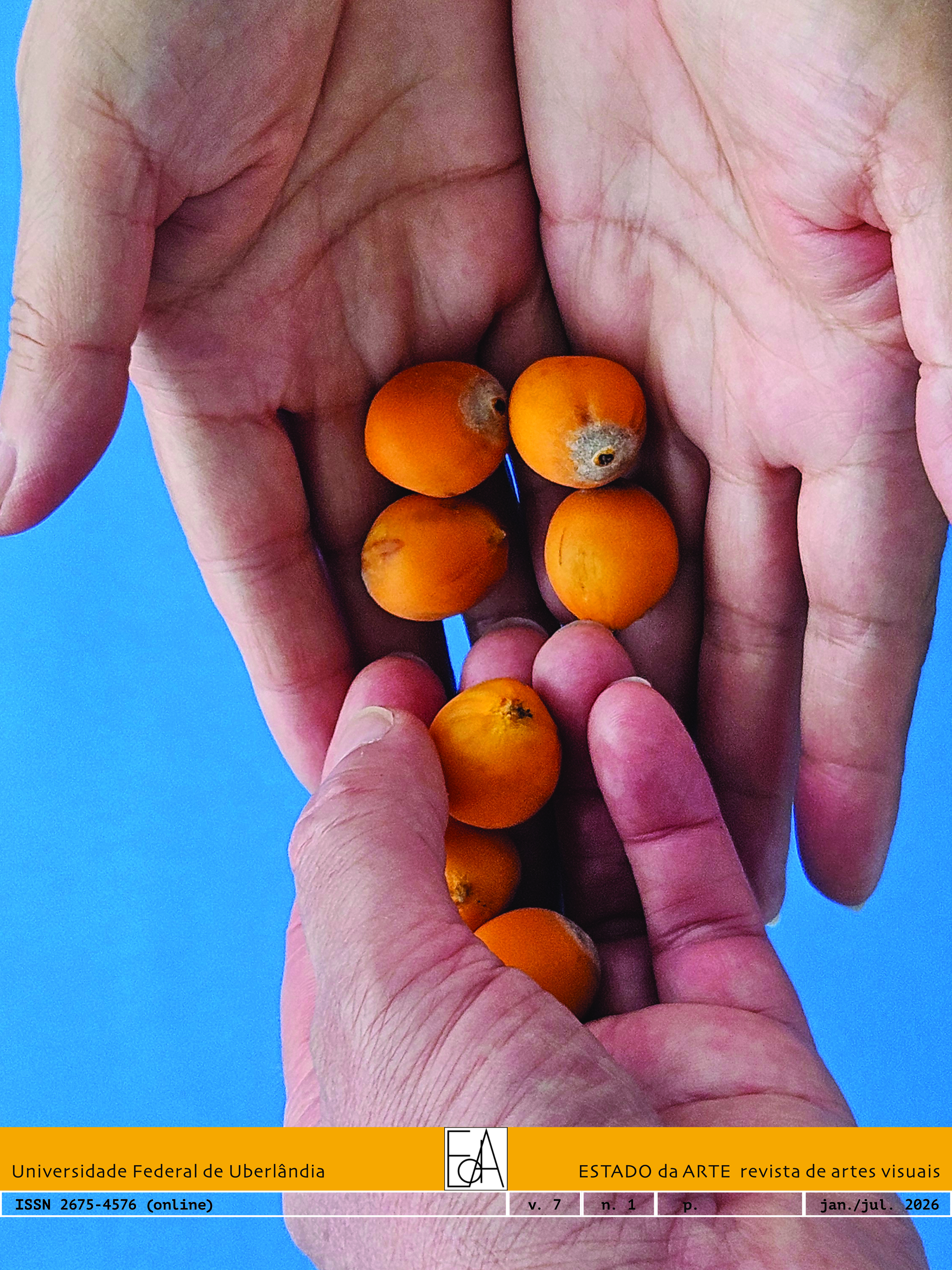
During a trip to Uruguay this summer, we encountered a jerivá palm (Syagrus romanzoffiana) in the central square of the town of Pan de Azúcar; it immediately caught our attention with its large, bountiful cluster of fruit. The jerivá is a palm species native to Brazil, as well as Argentina, Paraguay, and Uruguay. It can grow up to 30 meters tall, and its small, yellow-orange fruits serve as a food source for both humans and other living beings. According to Eduardo Navarro’s Dictionary of Old Tupi, the name derives from iara'ybá. An encounter with a plant can evoke resonances, connections, and relationships: with the geography of its origin, the soil type, the climate, specific places, other plants, birds, mammals, and insects, the etymology of its name, other people and groups, other times, and its shared history with us. This visual essay was created based on the harvesting of small fruits from this jerivá palm.They were incorporated into a sequence of relational hand gestures through which we conceive of engagement as contact.Computer and mobile phone screens saturate us with images and information, distancing us from direct experience with the things of the world.To grope or feel around is to sense and probe a body’s shape, weight, texture, thickness, and resistance with one’s hands. The act of touching gives rise to contact and communication, but also to apprehension—as difference, as limit, and as otherness.The essay also represents a convergence of our artistic practices and research, intertwining urban foraging, performances, gestures, and extensions of both body and memory.