
Keywords
Multidimensional Deprivation
Socio-spatial Inequalities
Multi-attribute Model
How to Cite




Abstract
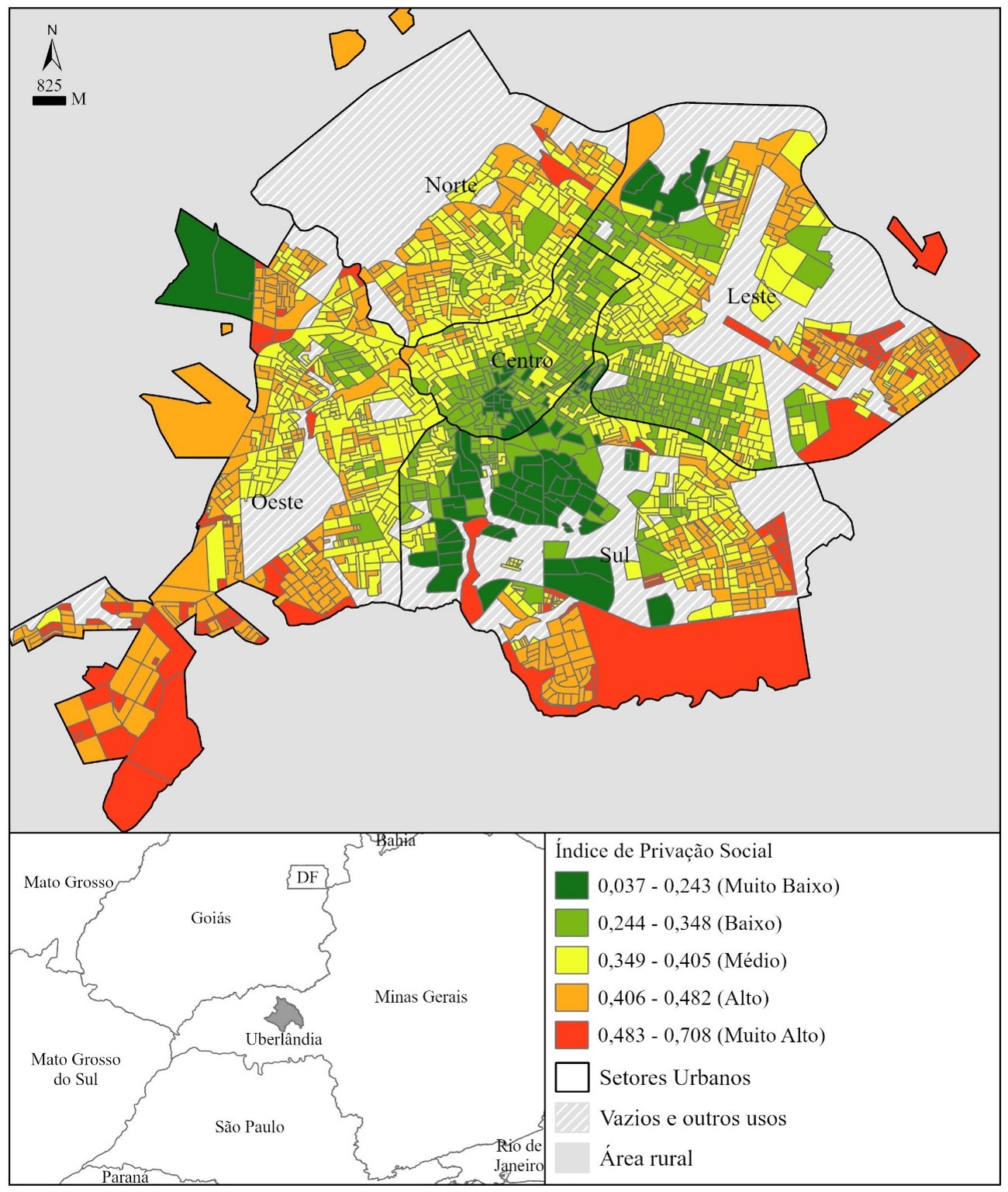
Urban poverty can be understood as the deprivation of the freedom to access goods and values considered important within a given society. It is a complex phenomenon to evaluate, as it requires multidimensional measures adapted to local realities. This study aims to develop and apply a multi-criteria model to assess urban poverty in Uberlândia, the second-largest city in the state of Minas Gerais, Brazil. The methodology was based on the selection and prioritization of indicators derived from the 2022 Demographic Census of IBGE. Fifteen indicators were selected, covering the dimensions of income, education, demographics, neighborhood surroundings, and housing conditions. These indicators were standardized through linear normalization, weighted using the Analytic Hierarchy Process (AHP), and aggregated via weighted linear combination. The outcome was the construction of the Social Deprivation Index of Uberlândia (IPSUDI), ranging from 0 to 1 and expressed in five classes defined using the natural breaks method. The analyses employed exploratory spatial data techniques and dependency assessment using Global and Local Moran’s I statistics. The results revealed clusters of high social deprivation throughout the peripheral zones of Uberlândia, contrasting with low-deprivation areas in the central, southern, and parts of the eastern regions. High-deprivation areas were found to concentrate younger populations and higher proportions of Black and Brown residents, whereas low-deprivation areas tended to be older and predominantly White. The study concludes that poverty in Uberlândia is a spatially structured and socially determined phenomenon, reproducing racial and generational inequalities. The multi-criteria model proved to be an effective tool for evaluating intraurban poverty, reinforcing the need for integrated public policies that address the multiple dimensions of deprivation and the structural mechanisms that perpetuate inequality.
References
ALKIRE, S.; FOSTER, J. Counting and multidimensional poverty measurement. Journal of Public Economics, v. 95, n. 7–8, p. 476–487, 2011. https://doi.org/10.1016/j.jpubeco.2010.11.006
ALLIK, M.; LEYLAND, A.; ICHIAHARA, M. Y. Y.; DUNDAS, R. Creating small-area deprivation indices: a guide for stages and options. Journal of Epidemiology and Community Health, v. 74, n. 1, p. 20–25, 2020. https://doi.org/10.1136/jech-2019-213255
ALMEIDA, S. Racismo estrutural. São Paulo: Pólen, 2019.
ANSELIN, L. Local Indicators of Spatial Association—LISA. Geographical Analysis, v. 27, n. 2, p. 93–115, 3 abr. 1995. https://doi.org/10.1111/j.1538-4632.1995.tb00338.x
BARROS, R. P.; FIRPO, S. P.; GUEDES, R.; LEITE, P. G. Demographic changes and poverty in Brazil. 1. ed. Brasília: Instituto de Pesquisas Econômicas Aplicadas, 2015.
BARROZO, L. V.; FORNACIALI, M.; ANDRÉ, C. D. S.; MORAIS, G. A. Z.; MANSUR, G. CABRAL-MIRANDA, W.; MIRANDA, M. J.; SATO, J. R.; AMARO JÚNIOR, E. GeoSES: A socioeconomic index for health and social research in Brazil. PLOS ONE, v. 15, n. 4, p. e0232074, 2020. https://doi.org/10.1371/journal.pone.0232074
BESSA, K. C.; SOARES, B. R. Vazios urbanos e especulação imobiliária em Uberlândia-MG. Sociedade e Natureza, v. 3, n. 16, p. 163–168, 1996.
BOING, A. F.; BOING, A. C.; WAGNER, K. J. P.; SUBRAMANIAN, S. V. Narrowing geographic inequality in life expectancy in Brazil: a multilevel analysis between 1991 and 2010. Public Health, v. 180, p. 102–108, 2020. https://doi.org/10.1016/j.puhe.2019.11.015
BOOTH, C. Life and Labour of the People in London. London: Macmillan and Co., 1889.
CARSTAIRS, V.; MORRIS, R. Deprivation and health in Scotland. Health Bull (Edinb), v. 48, n. 4, p. 162–175, 1990.
CHIAVEGATTO FILHO, A. D.; KAWACHI, I. Income inequality is associated with adolescent fertility in Brazil: a longitudinal multilevel analysis of 5,565 municipalities. BMC Public Health, v. 15, n. 1, p. 103, 2015. https://doi.org/10.1186/s12889-015-1369-2
ESRI - Environmental Systems Research Institute. ArcGIS Pro (Versão 3.5) [Software de computador]. 2025. Disponível em: https://www.esri.com/pt-br/arcgis/products/arcgis-pro/overview. Acesso em: 12 jun. 2026.
GUIMARÃES, J. M. N.; YAMADA, G.; BARBER, S.; CAIAFFA, W. T.; FRICHE, A. A. L.; MENEZES, M. C.; SANTOS, G.; SANTOS, I.; CARDOSO, L. O.; DIEZ ROUX, A. V. Racial Inequities in Self-Rated Health Across Brazilian Cities: Does Residential Segregation Play a Role? American Journal of Epidemiology, v. 191, n. 6, p. 1071–1080, 2022. https://doi.org/10.1093/aje/kwac001
GUIMARÃES, R. M.; ANDRADE, F. C. D. Healthy life-expectancy and multimorbidity among older adults: Do inequality and poverty matter? Archives of Gerontology and Geriatrics, v. 90, p. 104157, 2020. 10.1016/j.archger.2020.104157
IBGE - Instituto Brasileiro de Geografia e Estatística. Censo Demográfico 2022: características gerais da população e dos domicílios: resultados do universo. Disponível em: https://censo2022.ibge.gov.br/panorama. Acesso em: 05 maio 2025.
ICHIHARA, M. Y. T.; RAMOS, D.; REBOUÇAS, P.; OLIVEIRA, F. J.; FERREIRA, A. J. F.; TEIXEIRA, C.; ALLIK, M.; KATIKIREDDI, S. V.; BARRETO, M. L.; LEYLAND, A. H.; DUNDAS, R. Area deprivation measures used in Brazil. Revista de Saúde Pública, v. 52, p. 83, 30 ago. 2018. 10.11606/S1518-8787.2018052000933
IPEA - Instituto de Pesquisa Econômica Aplicada. Atlas do desenvolvimento humano no Brasil. Brasília, DF: IPEA, 2020. Disponível em: https://www.undp.org/pt/brazil/desenvolvimento-humano/atlas-do-desenvolvimento-humano-no-brasil. Acesso em: 24 fev. 2026.
MARCELINO, G. C.; CUNHA, M. S. da. Multidimensional poverty in Brazil: evidences for rural and urban areas. Revista de Economia e Sociologia Rural, v. 62, n. 1, 2024. http://dx.doi.org/10.1590/1806-9479.2022.266430pt
MARICATO, E. Para entender a crise urbana. São Paulo: Expressão Popular, 2015.
MOTTA, G. A. S. Fragmentos urbanos: segregação socioespacial em Uberlândia - MG. São Paulo: Universidade Presbiteriana Mackenzie, 2019.
https://doi.org/10.22533/at.ed.1571905096
ORSHANSKY, M. Counting the Poor: Another Look at the Poverty Profile. Social Security Bulletin. Social Security Bulletin, v. 28, n. 1, p. 3–29, 1965.
PERES, O. M.; SABOYA, R. Segregação socioespacial, morfologia da expansão e fragmentação socioeconômica em cidades brasileiras de porte médio. urbe. Revista Brasileira de Gestão Urbana, v. 16, 2024. https://doi.org/10.1590/2175-3369.016.e20230192
PNUD - Programa das Nações Unidas para o Desenvolvimento; IPEA, Instituto de Pesquisa Econômica Aplicada; FJP, Fundação João Pinheiro. Atlas do Desenvolvimento Humano no Brasil. 2020. Disponível em: http://www.atlasbrasil.org.br/. Acesso em: 27 set. 2025.
RIBAS, R. P. A caracterização da pobreza urbana ao longo do tempo: aplicação do modelo idade-período-coorte na estimação das tendências de privações crônica e transitória no Brasil. Revista Brasileira de Estudos de População, v. 24, n. 1, p. 139–161, 2007. https://doi.org/10.1590/S0102-30982007000100009
ROWNTREE, B. S. Poverty: A Study of Town Life. London: Macmillan and Co., 1901.
SAATY, T. L. How to make a decision: The analytic hierarchy process. European Journal of Operational Research, v. 48, n. 1, p. 9–26, 1990. https://doi.org/10.1016/0377-2217(90)90057-I
SEN, A. Desenvolvimento como liberdade. São Paulo: Companhia das Letras, 2010.
SOUZA, J. A ralé brasileira: quem é e como vive. 2. ed. Rio de Janeiro: Civilização Brasileira, 2024a.
SOUZA, T. S. Urbanização informal e reprodução do espaço: Uberlândia – MG e as irregularidades socioespaciais no campo e na cidade. 2024b. 251 f. Tese (doutorado em Geografia) – Universidade Federal de Uberlândia, Uberlândia, 2024b.
SPODE, P. L. C.; FARIA, R. Privação Social e Pobreza na Cidade de Santa Maria, Rio Grande do Sul: Análise a partir das Periferias Populares de Alta Privação Social. Sociedade & Natureza, v. 37, n. 1, 2025. https://doi.org/10.14393/SN-v37-2025-75531
SPOSITO, M. E. B. A produção do espaço urbano: escalas, diferenças e desigualdades socioespaciais. In: CARLOS, A, F.; SOUZA, M. L.; SPÓSITO, M. E. B. (Org.). A produção do espaço urbano: agentes e processos, escalas e desafios. 1. ed. São Paulo: Contexto, p. 123–145, 2011.
STANKIEWICZ, A. S.; YALONETZKY, G. I.; MAIA, A. G. Multidimensional Poverty in Brazil in the Early 21st Century: Evidence from the Demographic Census. Social Indicators Research, v. 154, n. 1, p. 79–114, 2021. https://doi.org/10.1007/s11205-020-02568-5
TAVARES, F. F.; BETTI, G. Gender Differences in Multidimensional Poverty in Brazil: A Fuzzy Approach. Social Indicators Research, v. 175, n. 2, p. 385–422, 2024. https://doi.org/10.1007/s11205-024-03312-z
TOWNSEND, P. Poverty in the United Kingdom: A Survey of Household Resources and Standards of Living. London: Penguin Books, 1979.
https://doi.org/10.1525/9780520325760
UNDP - United Nations Development Programme. Human Development Report 1990: Concept and Measurement of Human Development. New York: Oxford University Press, 1990.
UNDP - United Nations Development Programme; OPHI, Oxford Poverty and Human Development Initiative. Multidimensional poverty index 2024. New York: UNDP, 2024.
VILLAÇA, F. Espaço intra-urbano no Brasil. 2. ed. Rio de Janeiro: Studio Nobel, 2017.

This work is licensed under a Creative Commons Attribution 4.0 International License.
Copyright (c) 2025 Rivaldo Faria, Ligia Vizeu Barrozo