
Keywords
Types of Islands
Archipelagos of Macaronesia
How to Cite




Abstract
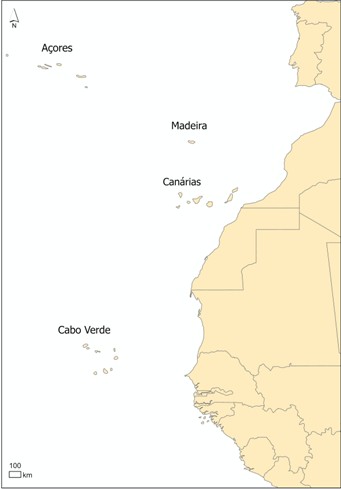
The Earth’s surface has a vast number of island territories that vary greatly in size, to the point of complicating the process of creating categories for different land areas. This article explores the proposal put forward by Depraetere and Dahl (2007; 2018) for delimiting island areas and, mainly, to arrive at a concept of islands and their categories, in order to subsequently apply this typology to the island units of Macaronesia. In this context, it is essential to determine the limits for the islet and mainland given that the concept of the island is precisely framed by these two types of island spaces. The primary objective is to discuss the concept of the island, mainly from the perspective of the size of the territories. We also set out to explain the main reasons why certain islands are not suited to human occupation. In order to achieve these objectives, we opted for a type of methodology that favoured a literature review, adapting a model for classifying reference island areas and the processing of information from statistical sources. In terms of the results, it is worth highlighting the fact that we have kept the original proposal of 10 km² as the starting point for an island territory to be considered an island. This decision allowed for 31 islands to be counted in the entire Atlantic region of Macaronesia, three of which are currently uninhabited. This type of classification does not alter the number of islands commonly recognised in the Azores and Cape Verde, although the same is not true for others. The average size of the island units varies from archipelago to archipelago and the size of the territory, while important, is never the decisive circumstance for settlement.
References
BALDACCHINO, G. Valuing: Why Should We Study Islands and Archipelagos? In: Stratford, E.; Baldacchino, G.; MacMahon, E. Rethinking Island Methodologies. London: Rowman & Littlefield, p. 21-33, 2023. https://doi.org/10.5040/9798881813659.ch-2
BIAGINI, E.; HOYLE, B. Insularity and Development on an Oceanic Planet. In: Biagini, E.; Hoyle, B. (Org.) Insularity and Development: International Perspectives on Islands. London and New York: Pinter, p.1-14, 1999.
BONNEMAISON, J. Vivre dans l´île: une approche de l`îléité océanienne. L`Espace Géographique, v. 19-20, n. 2, p. 119-125, 1990. https://doi.org/10.3406/spgeo.1990.2961
BRITO-HENRIQUES, E. Distância e Conexão: Insularidade, relações culturais e sentido de lugar no espaço da Macaronésia. Angra do Heroísmo/Lisboa: Instituto Açoriano de Cultura/Centro de Estudos Geográficos da Universidade de Lisboa, 2009.
BRUNET, R.; FERRAS, R.; THÉRY, H. Les mots de la géographie, dictionnaire critique. 3 ed. Paris/Montpellier: La Documentation française/Reclus, 1993.
BRUNET, R. Quelle est la plus grand île du monde? MappeMonde, v. 4, p. 40-41, 1997. https://doi.org/10.3406/mappe.1997.2267
CRUZ, D. La incongruencia de La Graciosa como octava isla: el Estatuto de Autonomía de Canarias dice que sí, administrativamente no lo es. Jornal El Día. Santa Cruz de Tenerife, 17 set. 2024. Disponível em:
https://www.eldia.es/sociedad/2024/09/17/incongruencia-la-graciosa-octava-isla-dv-108250507.html. Acesso em:10 fev. 2025.
DEPRAETERE, C. Le phénomène à l`échelle du globe: tailles, hiérarchies et forms des îles oceans. L`Espace Géographique, v. 2, p. 126-134, 1991. Disponível em: https://www.persee.fr/doc/spgeo_0046-2497_1990_num_19_2_2962. Acesso em: 15 jan. 2025.
DEPRAETERE, C.; DAHL, A. Locations & Classifications. In: BALDACCHINO, G. (Org.) A World of islands: An Island Studies Reader. Malta & Canada: Agenda Academic and Institute of Islands Studies, p. 57-105, 2007. https://doi.org/10.3406/spgeo.1990.2962
DEPRAETERE, C.; DAHL, A. Locations & Classifications. In: BALDACCHINO, G. (Org.) The Routledge International Handbook of Island Studies: A World of Islands. London & New York: Routledge – Taylor & Francis Group, p. 21-51, 2018. https://doi.org/10.4324/9781315556642-2
DREM – Direção Regional de Estatística da Madeira. Retrato Territorial da Região Autónoma da Madeira, 2023. Disponível em: https://estatistica.madeira.gov.pt/download-now/ambiente-territorio/retrato-territorial/publicacao-retrato-territorial/send/734-retrato-territorial-publicacao/16616-retrato-territorial-da-r-a-madeira-dinamicas-territoriais-censos-2021.html. Acesso em: 20, nov. 2024.
FERREIRA, J. A Espanha, As Selvagens, Olivença e etc. In: DAEHNHARD, R.; FERREIRA, J.; COUTINHO, G.; VASCONCELOS, E. (Org.) As nossas Ilhas Selvagens disputadas no jogo geoestratégico. Portimão: Apeiron Editores, p. 51-67, 2014.
GRAÇA, P. A importância das ilhas no quadro das políticas e do direito do mar. O caso das ilhas Selvagens. Lisboa: Chiado Editora, 2014.
INE-CV – Instituto Nacional de Estatística de Cabo Verde. Anuário Estatístico de Cabo Verde – 2016, 2017. Disponível em: https://bdmi.ine.cv/site_deploy_api/Uploads/20250401_141525_8603d2f0-2645-4124-9b82-51326de5cb74.pdf. Acesso em: 20 nov. 2024.
ISTAC – Instituto Canario de Estadística. Estadísticas del Territorio, 2024. Disponível em: https://www3.gobiernodecanarias.org/istac/statistical-visualizer/visualizer/data.html?resourceType=dataset&agencyId=ISTAC&resourceId=X00004A_000001&version=%7Elatest#visualization/table. Acesso em: 21, nov. 2024.
JEDRUSIK, M. H. Island Studies. Island Geography. But what is an Island? Miscellanea Geographica, v.15, p. 201-212, 2011. http://dx.doi.org/10.2478/v10288-012-0012-7
KING, R. The Geographical Fascination of Islands. In: LOCKHART, D.; DRAKAKIS-SMITH, D.; SCHEMBRI, J. (Org.) The Development Process in Small States. London: Routledge, p. 13-37, 1993.
LOVEGROVE, R. Islands beyond the Horizon: The life of twenty of the world`s most remote places. Oxford: Oxford University Press, 2012.
NUNN, P. Oceanic Islands. Oxford: Blackwell Publishers, 1994.
PÉRON, F. The Contemporary Lure of The Island. Tijdschrift voor Economische en Sociale Geografie, v.95, n. 3, p.326 – 339, 2004. http://dx.doi.org/10.1111/j.1467-9663.2004.00311.x
PETZOLD, J. Social Capital, Resilience and Adaptation on Small Islands: Climate Change on the Isles of Sicilly. Hamburg: Springer. 2017. https://doi.org/10.1007/978-3-319-52225-8
PLEIJEL, C.; LUNDBERG, C.; PROST, P. The Habitability Handbook: An assessment tool for viable island communities. The Archipelago Sea Institute at Abo Akademi University, 2022. Disponível em: https://www.abo.fi/wp-content/uploads/2024/05/the-habitability-handbook_english.pdf. Acesso em: 27 ago. 2025.
PORTO EDITORA – Ilha na Infopédia. Porto: Porto Editora. Disponível em: https://www.infopedia.pt/dicionarios/lingua-portuguesa/ilha. Acesso em: 12 out. 2024.
Portugal. Resolução da Assembleia da República n.º 60-B/97, de 14 de outubro de 1997. Aprova, para ratificação, a Convenção das Nações Unidas sobre o Direito do Mar e o Acordo Relativo à Aplicação da Parte XI da mesma Convenção. Disponível em: https://diariodarepublica.pt/dr/detalhe/resolucao-assembleia-republica/60-b-1997-152897. Acesso em: 15 jun. 2025.
RANDALL, J. E. An Introduction to Island Studies. London: Rowman & Littlefield International, 2021. https://doi.org/10.1007/978-3-319-63869-0
RATTER, B. Geography of Small Islands. New York: Springer, 2018.
ROYLE, S. A Geography of Islands: Small Island. London: Routledge, 2001. https://doi.org/10.4324/9780203160367
ROYLE, S. Islands: Nature and Culture. London: Reaktion Books, 2014.
SREA – Serviço Regional de Estatística dos Açores. Censos 2011 Principais Resultados Definitivos dos Censos 1991, 2001 e 2011, 2012. Disponível em: https://srea.azores.gov.pt/wp-content/uploads/2025/11/Censos-1991_2001_2011.pdf. Acesso em: 20, nov. 2024.
TAGLIONI, F. Insularity, Political Status and Small Insular Spaces. Shima, v. 5, n. 2, p. 45-67, 2011.
https://www.shimajournal.org/issues/v5n2/f.-Taglioni-Shima-v5n2-45-67.pdf. Acesso em: 14, mai. 2025.
YOUNG, L. Islands: Portraits of Miniature Worlds. New York: W. H. Freeman and Company, 1999.

This work is licensed under a Creative Commons Attribution 4.0 International License.
Copyright (c) 2025 Paulo Miguel Picanço Espínola, Fernanda Maria Silva Dias Delgado Cravidão