
Keywords
Remote sensing
Water consumption
Forestry
How to Cite




Abstract
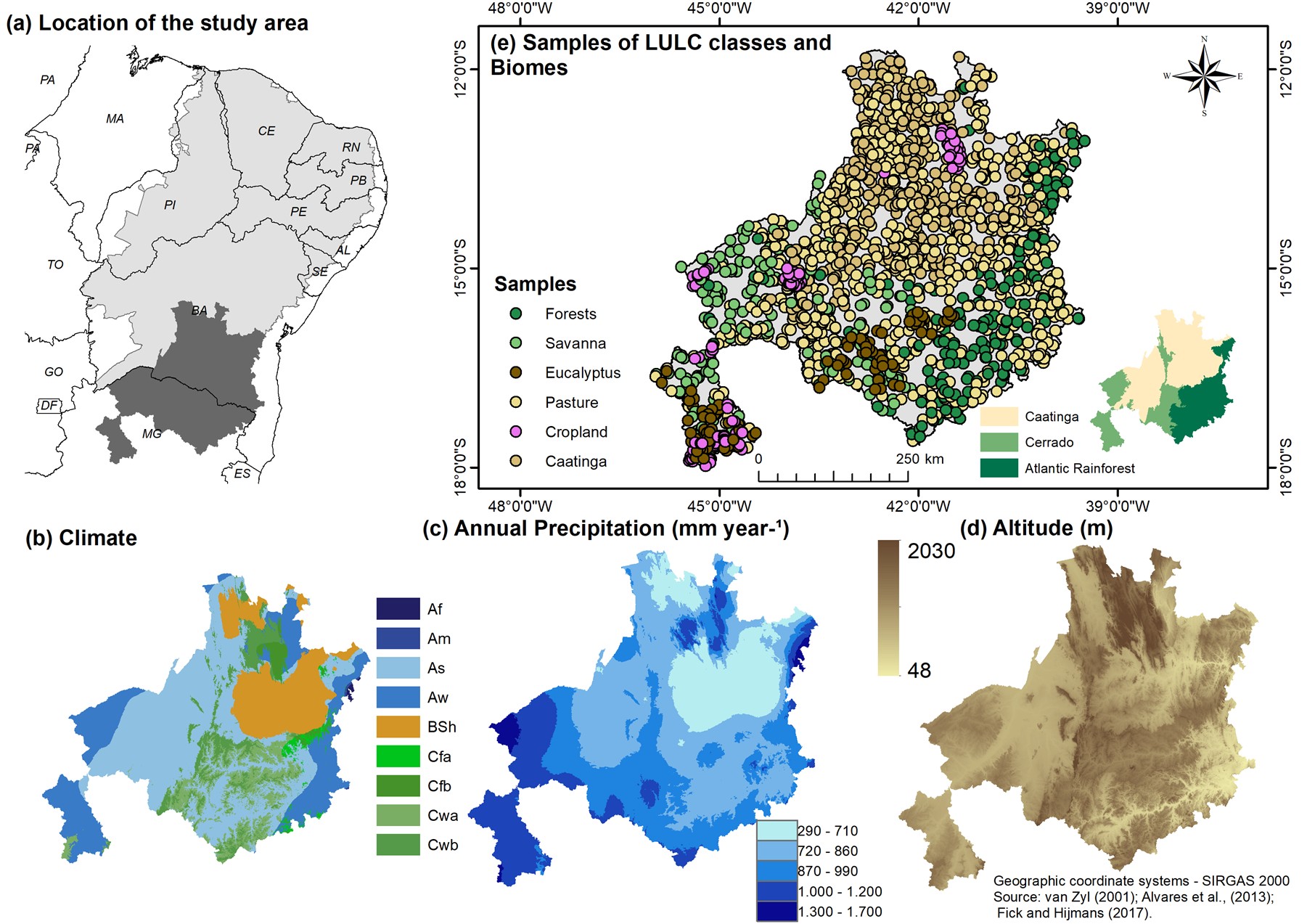
Water consumption by evapotranspiration (ET) of eucalyptus plantations is a concern widely addressed worldwide. However, in the semiarid region of Brazil, a region characterized by recurring water deficit, there is a gap in the knowledge on the effects of eucalyptus plantations on ET dynamics. Therefore, this study aimed to compare the ET rates of eucalyptus to native forests, savannas (Cerrado), dry woodlands (caatingas), pastures, and croplands in the Brazilian semiarid region (BSR). The methodological structure followed the use of remote sensing techniques and statistical tests. From the Google Earth Engine (GEE) platform, monthly and annual ET images for 2022 were obtained from the MOD16A2 product. The results of this study indicated that eucalyptus had significantly higher ET rates (Kruskal-Wallis test followed by the Dunn test; p-value <0.05) compared to most classes. Exceptionally, native forests (Atlantic Forest) exhibited statistically similar (p-value >0.05) water consumption to eucalyptus. Worryingly, eucalyptus, as well as crops, maintained high ET rates during the dry season in the study region. These findings may inform water planning strategies in the Brazilian semiarid region, especially by indicating environmentally sensitive areas for high-impact eucalyptus plantations, where such activity should be restricted. Thus, this study provides substantial information for more sustainable agro-environmental development in semiarid zones.
References
AB’SÁBER, Aziz Nacib. Os domínios de natureza no Brasil: potencialidades paisagísticas. São Paulo: Ateliê Editorial, 2003. v. 1.
ADORNO, B. V., BARREIRA, S.; FERREIRA, M. E.; VELOSO, G. A. Influence of native and exotic tree plantations on biophysical indicators in the Brazilian Savanna. Pesquisa Agropecuária Tropical, v. 51, p. e65815, 2021. https://doi.org/10.1590/1983-40632021v5165815
ALLEN, R. G.; PEREIRA, L. S.; HOWELL, T. A.; JENSEN, M. E. Evapotranspiration information reporting: II. Recommended documentation. Agricultural Water Management, v. 98, n. 6, p. 921–929, 2011. https://doi.org/10.1016/j.agwat.2010.12.016
ALMEIDA, A. C.; SOARES, J. V. Comparação entre uso de água em plantações de Eucalyptus grandis e floresta ombrófila densa (Mata Atlântica) na costa leste do Brasil. Revista Árvore, v. 27, p. 159–170, 2003. https://doi.org/10.1590/S0100-67622003000200006
ALVARES, C. A.; STAPE, J. L.; SENTELHAS, P. C.; GONÇALVES, J. D. M.; SPAROVEK, G. Köppen's climate classification map for Brazil. Meteorologische Zeitschrift, v. 22, n. 6, p. 711–728, 2013. https://doi.org/10.1127/0941-2948/2013/0507
ANDRADE, R. G.; TEIXEIRA, A. H. D. C.; SANO, E. E.; LEIVAS, J. F.; VICTORIA, D. C.; NOGUEIRA, S. F. Pasture evapotranspiration as indicators of degradation in the Brazilian Savanna: a case study for Alto Tocantins watershed. In: Remote Sensing for Agriculture, Ecosystems, and Hydrology XVI, 2014, [s.l.]. Anais [...]. SPIE, 2014. p. 508–514. https://doi.org/10.1117/12.2067225
ANDRADE, B. C. C.; ANDRADE PINTO, E. J.; RUHOFF, A.; SENAY, G. B. Remote sensing-based actual evapotranspiration assessment in a data-scarce area of Brazil: a case study of the Urucuia Aquifer System. International Journal of Applied Earth Observation and Geoinformation, v. 98, p. 102298, 2021. https://doi.org/10.1016/j.jag.2021.102298
BARBOSA, H. A. Understanding the rapid increase in drought stress and its connections with climate desertification since the early 1990s over the Brazilian semi-arid region. Journal of Arid Environments, v. 222, p. 105142, 2024. https://doi.org/10.1016/j.jaridenv.2024.105142
BHATTARAI, N.; WAGLE, P. Recent advances in remote sensing of evapotranspiration. Remote Sensing, v. 13, n. 21, p. 4260, 2021. https://doi.org/10.3390/rs13214260
BRASIL. Lei da Mata Atlântica No. 11.428/2006. Available: https://www.planalto.gov.br/ccivil_03/_ato2004-2006/2006/lei/l11428.htm#:~:text=LEI%20N%C2%BA%2011.428%2C%20DE%2022%20DE%20DEZEMBRO%20DE%202006.&text=Disp%C3%B5e%20sobre%20a%20utiliza%C3%A7%C3%A3o%20e,Atl%C3%A2ntica%2C%20e%20d%C3%A1%20outras%20provid%C3%AAncias. Accessed on: jun 19, 2025.
BRASIL. Lei de Proteção à Vegetação No. 12.727/2012. Available: https://www.planalto.gov.br/ccivil_03/_ato2011-2014/2012/lei/l12727.htm. Acessed on: June 24, 2025.
CHANIE, T.; COLLICK, A. S.; ADGO, E.; LEHMANN, C. J.; STEENHUIS, T. S. Eco-hydrological impacts of Eucalyptus in the semi humid Ethiopian Highlands: the Lake Tana Plain. Journal of Hydrology and Hydromechanics, v. 61, n. 1, p. 21–29, 2013. https://doi.org/10.2478/johh-2013-0004
CHAO, L.; ZHANG, K.; WANG, J.; FENG, J.; ZHANG, M. A comprehensive evaluation of five evapotranspiration datasets based on ground and GRACE satellite observations: implications for improvement of evapotranspiration retrieval algorithm. Remote Sensing, v. 13, n. 12, p. 2414, 2021. https://doi.org/10.3390/rs13122414
CRISTIANO, P. M.; CAMPANELLO, P. I., BUCCI, S. J.; RODRIGUEZ, S. A.; LEZCANO, O. A.; SCHOLZ, F. G.; GOLDSTEIN, G. Evapotranspiration of subtropical forests and tree plantations: a comparative analysis at different temporal and spatial scales. Agricultural and Forest Meteorology, v. 203, p. 96–106, 2015. https://doi.org/10.1016/j.agrformet.2015.01.007
DUNN, O. J. Multiple comparisons using rank sums. Technometrics, v. 6, n. 3, p. 241–252, 1964.https://doi.org/10.1080/00401706.1964.10490181
ENKU, T.; MELESSE, A. M.; AYANA, E. K.; TILAHUN, S. A.; ABATE, M.; STEENHUIS, T. S. Groundwater use of a small Eucalyptus patch during the dry monsoon phase. Biologia, v. 75, n. 6, p. 853–864, 2020. https://doi.org/10.2478/s11756-020-00430-0
FERNANDES, M. F.; CARDOSO, D.; PENNINGTON, R. T.; QUEIROZ, L. P. The origins and historical assembly of the Brazilian Caatinga seasonally dry tropical forests. Frontiers in Ecology and Evolution, v. 10, 2022. https://doi.org/10.3389/fevo.2022.723286
BARROS FERRAZ, S. F.; RODRIGUES, C. B.; GARCIA, L. G.; ALVARES, C. A.; PAULA LIMA, W. Effects of Eucalyptus plantations on streamflow in Brazil: moving beyond the water use debate. Forest Ecology and Management, v. 453, p. 117571, 2019. https://doi.org/10.1016/j.foreco.2019.117571
FICK, S. E.; HIJMANS, R. J. WorldClim 2: new 1-km spatial resolution climate surfaces for global land areas. International Journal of Climatology, v. 37, p. 4302–4315, 2017. https://doi.org/10.1002/joc.5086
FRANCA ROCHA, W. J.; VASCONCELOS, R. N.; COSTA, D. P.; DUVERGER, S. G.; LOBÃO, J. S.; SOUZA, D. T.; AGUIAR, W. M. Towards uncovering three decades of LULC in the Brazilian Drylands: Caatinga Biome Dynamics (1985–2019). Land, v. 13, n. 8, p. 1250, 2024. https://doi.org/10.3390/land13081250
FU, Z., CIAIS, P.; WIGNERON, J. P.; GENTINE, P.; FELDMAN, A. F.; MAKOWSKI, D.; SMITH, W. K. Global critical soil moisture thresholds of plant water stress. Nature Communications, v. 15, n. 1, p. 4826, 2024. https://doi.org/10.1038/s41467-024-49244-7
GRÜNZWEIG, J. M.; DE BOECK, H. J.; REY, A.; SANTOS, M. J.; ADAM, O.; BAHN, M.; YAKIR, D. Dryland mechanisms could widely control ecosystem functioning in a drier and warmer world. Nature Ecology & Evolution, p. 1–13, 2022. https://doi.org/10.1038/s41559-022-01779-y
HUTLEY, L. B.; O'GRADY, A. P.; EAMUS, D. Evapotranspiration from Eucalypt open-forest savanna of Northern Australia. Functional Ecology, v. 14, n. 2, p. 183–194, 2000. https://doi.org/10.1046/j.1365-2435.2000.00416.x
IBGE – Instituto Brasileiro de Geografia e Estatística. Censo demográfico: 2010. Available: https://censo2010.ibge.gov.br/. Accessed on: nov. 26, 2023.
INMET – Instituto Nacional de Meteorologia. Catálogo de estações automáticas. Available: https://portal.inmet.gov.br/paginas/catalogoaut. Accessed on: jun. 19, 2025.
JARDIM, A. M. D. R. F.; ARAÚJO JÚNIOR, G. D. N.; SILVA, M. V. D.; SANTOS, A. D.; SILVA, J. L. B. D.; PANDORFI, H.; SILVA, T. G. F. D. Using remote sensing to quantify the joint effects of climate and land use/land cover changes on the Caatinga Biome of Northeast Brazilian. Remote Sensing, v. 14, n. 8, p. 1911, 2022. https://doi.org/10.3390/rs14081911
KIM, H. W.; HWANG, K.; MU, Q.; LEE, S. O.; CHOI, M. Validation of MODIS 16 global terrestrial evapotranspiration products in various climates and land cover types in Asia. KSCE Journal of Civil Engineering, v. 16, n. 2, p. 229–238, 2012. https://doi.org/10.1007/s12205-012-0006-1
KRUSKAL, W. H.; WALLIS, W. A. Use of ranks in one-criterion variance analysis. Journal of the American Statistical Association, v. 47, n. 260, p. 583–621, 1952.https://doi.org/10.1080/01621459.1952.10483441
LAPIG – Laboratório de Processamento de Imagens e Geoprocessamento. Atlas das pastagens. 2022. Available: https://lapig.iesa.ufg.br/p/38972-atlas-das-pastagens. Accessed on: nov. 27, 2024.
LEITE, M. E.; ALMEIDA, J. W. L.; SILVA, R. F. Análise espaço-temporal do eucalipto no Norte de Minas Gerais nos anos de 1986, 1996 e 2010. GeoTextos, 2012. https://doi.org/10.9771/1984-5537geo.v8i2.5931
LI, G.; ZHANG, F.; JING, Y.; LIU, Y.; SUN, G. Response of evapotranspiration to changes in land use and land cover and climate in China during 2001–2013. Science of The Total Environment, v. 596–597, p. 256–265, 2017. https://doi.org/10.1016/j.scitotenv.2017.04.080
LI, X.; ZOU, L.; XIA, J.; DOU, M.; LI, H.; SONG, Z. Untangling the effects of climate change and land use/cover change on spatiotemporal variation of evapotranspiration over China. Journal of Hydrology, v. 612, p. 128189, 2022. https://doi.org/10.1016/j.jhydrol.2022.128189
LIMA, W. P. Comparative evapotranspiration of Eucalyptus, Pine and natural "Cerrado" vegetation measure by the soil water balance method. IPEF International, v. 1, p. 5–11, 1990.
LIU, W.; WU, J.; FAN, H.; DUAN, H.; LI, Q.; YUAN, Y.; ZHANG, H. Estimations of evapotranspiration in an age sequence of Eucalyptus plantations in subtropical China. PLOS ONE, v. 12, n. 4, p. e0174208, 2017. https://doi.org/10.1371/journal.pone.0174208
MAPBIOMAS. Pontos de validação. 2023. Available: https://brasil.mapbiomas.org/pontos-de-validacao/. Accessed on: nov. 26, 2023.
MARENGO, J. A.; TORRES, R. R.; ALVES, L. M. Drought in Northeast Brazil – past, present, and future. Theoretical and Applied Climatology, v. 129, n. 3, p. 1189–1200, 2017. https://doi.org/10.1007/s00704-016-1840-8
MATTOS, T. S.; OLIVEIRA, P. T. S. D.; LUCAS, M. C.; WENDLAND, E. Groundwater recharge decrease replacing pasture by Eucalyptus plantation. Water, v. 11, n. 6, p. 1213, 2019. https://doi.org/10.3390/w11061213
MEDEIROS, R.; ANDRADE, J.; RAMOS, D.; MOURA, M.; PÉREZ-MARIN, A. M.; SANTOS, C. A.; CUNHA, J. Remote sensing phenology of the Brazilian Caatinga and its environmental drivers. Remote Sensing, v. 14, n. 11, p. 2637, 2022. https://doi.org/10.3390/rs14112637
MORO, M. F.; AMORIM, V. O.; DE QUEIROZ, L. P.; DA COSTA, L. R. F.; MAIA, R. P.; TAYLOR, N. P.; ZAPPI, D. C. Biogeographical districts of the Caatinga Dominion: a proposal based on geomorphology and endemism. The Botanical Review, 2024. https://doi.org/10.1007/s12229-024-09304-5
MU, Q.; ZHAO, M.; RUNNING, S. W. Improvements to a MODIS global terrestrial evapotranspiration algorithm. Remote Sensing of Environment, v. 115, n. 8, p. 1781–1800, 2011. https://doi.org/10.1016/j.rse.2011.02.019
NETO, S. P. G. C. Três décadas de Eucalipto no extremo Sul da Bahia. GEOUSP: Espaço e Tempo (Online), v. 16, n. 2, p. 55–68, 2012. https://doi.org/10.11606/issn.2179-0892.geousp.2012.74252
OGLE, D. H.; DOLL, J. C.; WHEELER, A. P. DINNO, A. FSA: Simple fisheries stock assessment methods. version 0.9.5, 2023. Available: https://cran.r-project.org/web/packages/FSA/index.html . Accessed on: nov. 19, 2024.
PAULA SOUSA JÚNIOR, V.; SPARACINO, J.; ESPINDOLA, G. M.; SOUSA DE ASSIS, R. J. Land-use and land-cover dynamics in the Brazilian Caatinga dry tropical forest. Conservation, v. 2, n. 4, p. 739–752, 2022. https://doi.org/10.3390/conservation2040048
PEIXOTO NETO, A. M.; CARTWRIGHT, I.; SILVA, M. R.; MCHUGH, I.; DRESEL, P. E.; TEODOSIO, B.; DALY, E. Linking evapotranspiration seasonal cycles to the water balance of headwater catchments with contrasting land uses. Hydrological Processes, v. 36, n. 12, p. e14784, 2022. https://doi.org/10.1002/hyp.14784
PENNINGTON, R. T.; LEHMANN, C. E. R.; ROWLAND, L. M. Tropical savannas and dry forests. Current Biology, v. 28, n. 9, p. R541–R545, 2018. https://doi.org/10.1016/j.cub.2018.03.014
QGIS. Spatial without Compromise QGIS Web Site. 2024. Available: https://www.qgis.org/. Accessed on: aug. 20, 2024.
RIBEIRO, J. F.; WALTER, B. M. Teles. Fitofisionomias do bioma cerrado. In: SANO, S. M.; ALMEIDA, S. P. (ed.). Cerrado: ecologia e flora. Planaltina: Embrapa Cerrados, 2008. p. 152–212.
PEIXOTO NETO, A. M.; CARTWRIGHT, I.; SILVA, M. R.; MCHUGH, I.; DRESEL, P. E.; TEODOSIO, B. Daly Assessment of the MODIS global evapotranspiration algorithm using eddy covariance measurements and hydrological modelling in the Rio Grande basin. Hydrological Sciences Journal, v. 58, n. 8, p. 1658–1676, 2013. https://doi.org/10.1080/02626667.2013.837578
RUNNING, S.; MU, Q.; ZHAO, M. MOD16A2 MODIS/Terra net evapotranspiration 8-day L4 global 500m SIN Grid v006. NASA EOSDIS Land Processes DAAC, v. 6, 2017. https://doi.org/10.5067/MODIS/MOD16A2.006
SAITER, F. Z.; EISENLOHR, P. V.; BARBOSA, M. R.; THOMAS, W. W.; OLIVEIRA-FILHO, A. T. From evergreen to deciduous tropical forests: how energy-water balance, temperature, and space influence the tree species composition in a high diversity region. Plant Ecology & Diversity, v. 9, n. 1, p. 45–54, 2016. https://doi.org/10.1080/17550874.2015.1075623
SALES, L. P.; PIRES, M. M. Identifying climate change refugia for South American biodiversity. Conservation Biology, v. 37, n. 4, p. e14087, 2023. https://doi.org/10.1111/cobi.14087
SAMPAIO, G.; NOBRE, C.; COSTA, M. H.; SATYAMURTY, P.; SOARES‐FILHO, B. S.; CARDOSO, M. Regional climate change over eastern Amazonia caused by pasture and soybean cropland expansion. Geophysical Research Letters, v. 34, n. 17, 2007. https://doi.org/10.1029/2007GL030612
SANTOS, W. R.; JARDIM, A. M. D. R. F.; DE SOUZA, L. S. B.; DE SOUZA, C. A. A.; MORAIS, J. E. F.; ALVES, C. P.; SILVA, T. G. F. Can changes in land use in a semi-arid region of Brazil cause seasonal variation in energy partitioning and evapotranspiration? Journal of Environmental Management, v. 367, p. 121959, 2024. https://doi.org/10.1016/j.jenvman.2024.121959
SCHUME, H.; HAILU, Z.; HAILU, T.; SIEGHARDT, M.; GODBOLD, D. L. Spatial analysis of soil water depletion and biomass production in the transition zone between a Eucalyptus camaldulensis stand and a maize field in Ethiopia. Agricultural and Forest Meteorology, v. 320, p. 108956, 2022. https://doi.org/10.1016/j.agrformet.2022.108956
SHI, Z.; XU, D.; YANG, X.; JIA, Z.; GUO, H.; ZHANG, N. Ecohydrological impacts of Eucalypt plantations: a review. Journal of Food, Agriculture and Environment, v. 10, p. 1419–1426, 2012.
SILVA, B. B.; WILCOX, B. P.; SILVA, V. D. P. R.; MONTENEGRO, S. M. G. L.; OLIVEIRA, L. M. M. Changes to the energy budget and evapotranspiration following conversion of tropical savannas to agricultural lands in São Paulo State, Brazil. Ecohydrology, v. 8, n. 7, p. 1272–1283, 2015. https://doi.org/10.1002/eco.1580
SILVA, L. A.; DE SOUZA, C. M. P.; LEITE, M. E.; FILGUEIRAS, R. Estimativa da perda de água na APA do Rio Pandeiros, Minas Gerais. Caderno de Geografia, v. 30, n. 62, p. 768, 2020. https://doi.org/10.5752/P.2318-2962.2020v30n62p768
SOUZA JR, C. M.; Z. SHIMBO, J.; ROSA, M. R.; PARENTE, L. L.; A. ALENCAR, A.; RUDORFF, B. F.; AZEVEDO, T. Reconstructing three decades of land use and land cover changes in Brazilian biomes with Landsat archive and Earth Engine. Remote Sensing, v. 12, n. 17, p. 2735, 2020. https://doi.org/10.3390/rs12172735
TEIXEIRA, A.; LEIVAS, J.; TAKEMURA, C.; BAYMA, G.; GARÇON, E.; SOUSA, I.; SILVA, C. Remote sensing environmental indicators for monitoring spatial and temporal dynamics of weather and vegetation conditions: applications for Brazilian biomes. Environmental Monitoring and Assessment, v. 195, n. 8, p. 944, 2023. https://doi.org/10.1007/s10661-023-11560-8
VAN ZYL, J. J. The Shuttle Radar Topography Mission (SRTM): a breakthrough in remote sensing of topography. Acta Astronautica, v. 48, p. 559–565, 2001. https://doi.org/10.1016/S0094-5765(01)00020-0
WANG, Q.; CHENG, L.; ZHANG, L.; LIU, P.; QIN, S.; LIU, L.; JING, Z. Quantifying the impacts of land-cover changes on global evapotranspiration based on the continuous remote sensing observations during 1982–2016. Journal of Hydrology, v. 598, p. 126231, 2021. https://doi.org/10.1016/j.jhydrol.2021.126231
YANG, Z.; ZHANG, Q.; HAO, X.; YUE, P. Changes in evapotranspiration over global semiarid regions 1984–2013. Journal of Geophysical Research: Atmospheres, v. 124, n. 6, p. 2946–2963, 2019. https://doi.org/10.1029/2018JD029533
ZHANG, Y.; PEÑA-ARANCIBIA, J. L.; MCVICAR, T. R.; CHIEW, F. H.; VAZE, J.; LIU, C.; PAN, M. Multi-decadal trends in global terrestrial evapotranspiration and its components. Scientific Reports, v. 6, n. 1, p. 19124, 2016. https://doi.org/10.1038/srep19124
ZHANG, K; KIMBALL, J. S.; RUNNING, S. W. A review of remote sensing-based actual evapotranspiration estimation. WIREs Water, v. 3, n. 6, p. 834–853, 2016. https://doi.org/10.1002/wat2.1168

This work is licensed under a Creative Commons Attribution 4.0 International License.
Copyright (c) 2024 Marcos Esdras Leite, Samuel Carlos Santos Marques, Lucas Augusto Pereira da Silva, Cristiano Marcelo Pereira de Souza, Mario Marcos Espirito Santo, Maria das Dores Magalhães Veloso