
Keywords
Sensitivity Analysis
Child Mobility
Child-Friendly Cities
Geoprocessing
How to Cite




Abstract
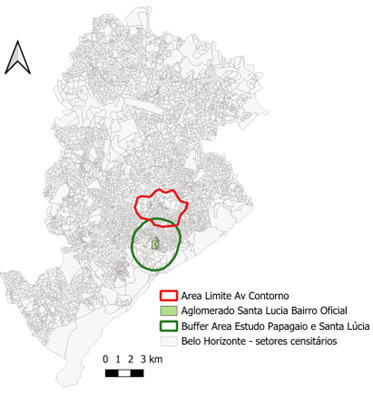
The article presents the use of geoinformation technologies to support the spatial analysis of the suitability of urban roads for independent child mobility, aiming to understand the differences in opportunities between planned areas of the city and unplanned areas, the latter being an example of social vulnerability. The case studies are developed in connected areas in Belo Horizonte, with the first being the traditional planned city and the second a section of a favela and its surroundings. It explores models of Multicriteria Analysis by Weights of Evidence and Sensitivity Analysis to Suitability Evaluation. Based on the careful selection of analysis variables, supported by an extensive literature review on the subject, thematic maps are created, which characterize each occupation condition, according to physical characteristics, presence of infrastructure, types of use, and human occupation of space. Once the maps have been created with the initial variables, the collection is integrated for the spatial representation of the level of spatial vulnerability, and the levels of uncertainty in the spatial distributions are evaluated. The result is the identification of the planned area as more conducive to child development, in comparison to the social vulnerability area. The approach presents defensible and reproducible criteria for other future case studies.
References
ADHIKHARI, D.; HENDERSON, T.; DOLCE, M.; BANKS, A.; ZAIM, H.; ONWUKA, A.; JONES, N. An evaluation of PlayStreets in the South Side neighborhood of Columbus, Ohio. Public Health, n. 141, p. 97–101, 2021.
https://doi.org/10.1177/1757913921990411
ATLES, R. K. Playable Street to reclaim independent play for all children. In: DANENBERG, R.; DOUMPA, V.; KARSSENBERG, H. (eds.). The City at Eye Level for Kids. Rotterdam: STIPO, 2018. p. 160–163.
BELO HORIZONTE (Município). BHMap – Sistema de Informações Geográficas de Belo Horizonte. Belo Horizonte: PBH, 2024. Disponível em: https://bhmap.pbh.gov.br. Acesso em: 17 jul. 2024.
BERRY, B. J. What is a model. GIS World, v. 8, n. 1, p. 26–28, 1995. https://doi.org/10.1088/2058-7058/8/11/25
BIDDULPH, M. Radical streets? The impact of innovative street designs on liveability and activity in residential areas. Urban Design International, n. 17, p. 178–205, 2012. https://doi.org/10.1057/udi.2012.13
BONHAM-CARTER, G. Geographic Information Systems for Geoscientists: modelling with GIS. Ottawa: Pergamon, 1994. 397 p.
CAKIR, S.; HECHT, R.; KRELLENBERGA, K. Sensitivity analysis in multi-criteria evaluation of the suitability of urban green spaces for recreational activities. AGILE: GIScience Series, v. 2, p. 22, 2021. https://doi.org/10.5194/agile-giss-2-22-2021
CANCIOVICI, C. The plinth—A portal to play. In: DANENBERG, R.; DOUMPA, V.; KARSSENBERG, H. (eds.). The City at Eye Level for Kids. Rotterdam: STIPO, 2018. p. 148–151.
CASTRO, D. M. Corners for kids: Quality spaces small scale. In: DANENBERG, R.; DOUMPA, V.; KARSSENBERG, H. (eds.). The City at Eye Level for Kids. Rotterdam: STIPO, 2018. p. 143–147.
COWEN, D. GIS versus CAD versus DBMS: what are the differences? In: PEUQUET, D.; MARBLE, D. (eds.). Introductory Readings in Geographic Information Systems. London: Taylor & Francis, 1990. p. 52–61.
DANENBERG, R.; DOUMPA, V.; KARSSENBERG, H. The City at Eye Level for Kids. Rotterdam: STIPO, 2018. 394 p.
DANGERMOND, J. A classification of software components commonly used in geographical information systems. In: MARBLE, D.; CALKINS, H.; PEUQUET, D. (eds.). Basic Readings in Geographic Information Systems. Amherst: SPAD Systems, 1983.
DIXON, B. N.; UGWOABA, U. A.; BROCKMANN, A. N.; ROSS, K. M. Associations between the built environment and dietary intake, physical activity, and obesity: A scoping review of reviews. Obesity Reviews, v. 22, e13171, 2021. https://doi.org/10.1111/obr.13171
FERREIRA, Inês A.; FORNARA, Ferdinando; PINNA, Vanessa; MANCA, Andrea; GUICCIARDI, Marco. Autonomy as key to healthy psychological well-being: A systematic literature review on children’s independent mobility, cognitive and socio-emotional development. Journal of Transport & Health, v. 38, p. 101837, 2024. https://doi.org/10.1016/j.jth.2024.101837
FROHLICH, Katherine L.; COLLINS, Patricia A. Children’s right to the city and their independent mobility: why it matters for public health. Journal of Epidemiology and Community Health, v. 78, n. 1, p. 66–68, 2024. https://doi.org/10.1136/jech-2023-221067
HUGGETT, R. Systems analysis in geography: contemporary problems in geography. Oxford: Clarendon Press, 1980. 208 p.
IBGE – Instituto Brasileiro de Geografia e Estatística. Censo Demográfico 2022: resultados. Rio de Janeiro: IBGE, 2023. Disponível em: https://www.ibge.gov.br. Acesso em: 12 dez. 2024.
IGEL, U.; GAUSCHE, R.; KRAPF, A.; LÜCK, M.; KIESS, W.; GRANDE, G. Movement-enhancing footpaths—A natural experiment on street design and physical activity in children in a deprived district of Leipzig, Germany. Preventive Medicine Reports, v. 20, 101197, 2020. https://doi.org/10.1016/j.pmedr.2020.101197
IKEDA, E.; STEWART, T.; GARRETT, N.; EGLI, V.; MANDIC, S.; HOSKING, J.; WITTEN, K.; HAWLEY, G.; TAUTOLO, E. S.; RODDA, J.; MOORE, A.; SMITH, M. Built environment associates of active school travel in New Zealand children and youth: A systematic meta-analysis using individual participant data. Journal of Transport & Health, v. 9, p. 117–131, 2018. https://doi.org/10.1016/j.jth.2018.04.007
LACHOWYCZ, K.; JONES, A. P.; PAGE, A. S.; WHEELER, B. W.; COOPER, A. R. What can global positioning systems tell us about the contribution of different types of urban greenspace to children’s physical activity? Health & Place, v. 18, p. 586–594, 2012. https://doi.org/10.1016/j.healthplace.2012.01.006
LEVNER, A. Turning spaces into places. In: DANENBERG, R.; DOUMPA, V.; KARSSENBERG, H. (eds.). The City at Eye Level for Kids. Rotterdam: STIPO, 2018. p. 127–129.
LIGMANN-ZIELINSKA, A.; JANKOWSKI, P. A framework for sensitivity analysis in spatial multiple criteria evaluation. In: COVA, T. J.; MILLER, H. J.; BEARD, K.; FRANK, A. U.; GOODCHILD, M. F. (eds.). Geographic Information Science. Berlin: Springer, 2008. p. 217–232. https://doi.org/10.1007/978-3-540-87473-7_14
MALCZEWSKI, J.; RINNER, C. Multicriteria Decision Analysis in Geographic Information Science. New York: Springer, 2015. https://doi.org/10.1007/978-3-540-74757-4
MORENO, C. La ville du quart d'heure: pour un nouveau chrono urbanisme. 2016. Disponível em: https://www.latribune.fr/regions/smartcities/la-tribune-de-carlos-moreno/la-ville-du-quart-d-heure-pour-un-nouveauchrono-urbanisme-604358.html. Acesso em: 10 fev. 2024.
MOURA, A. C. M.; JANKOWSKI, P. Contribuições aos estudos de análises de incertezas como complementação às análises multicritérios – “Sensitivity Analysis to Suitability Evaluation”. Revista Brasileira de Cartografia, n. 68/4, p. 665–684, 2016. https://doi.org/10.14393/rbcv68n4-44274
MOURA, A. C. M.; ROSA, A. A.; BARROS, P. Children’s independent mobility in urban planning: geospatial technology with a technical approach and citizens’ listening. Geographies, v. 4, p. 115–140, 2024. https://doi.org/10.3390/geographies4010008
PAN, X.; ZHAO, L.; LUO, J.; YINHAO, L.; ZHANG, L.; WU, T.; SMITH, M.; DAI, S.; JIA, P. Access to bike lanes and childhood obesity: A systematic review and meta-analysis. Obesity Reviews, v. 22, e13042, 2021. https://doi.org/10.1111/obr.13042
SAVOLAINEN, E.; LINDQVIST, A. K.; FORSBERG, H.; RUTBERG, S. Accompaniment, benefits, and community connection: Voicing children’s perspectives on independent active transport. Journal of Transport & Health, v. 44, p. 102096, 2025. https://doi.org/10.1016/j.jth.2025.102096
SECONDINI, P. (org.). La conoscenza del territorio e dell’ambiente: il ruolo delle tecnologie dell’informazione. Milano: Enidata, 1988. 269 p. (Coleção Dati & Fatti).
SMITH, M.; HOSKING, J.; WOODWARD, A.; WITTEN, K.; MACMILLAN, A.; FIELD, A.; BAAS, P.; MACKIE, H. Systematic literature review of built environment effects on physical activity and active transport—An update and new findings on health equity. International Journal of Behavioral Nutrition and Physical Activity, v. 14, p. 158, 2017. https://doi.org/10.1186/s12966-017-0613-9
STEINITZ, C. A framework for geodesign: changing geography by design. Redlands: ESRI, 2012.
TOMLINSON, R. Geographic Information System – new frontier. In: PEUQUET, D.; MARBLE, D. (eds.). Introductory Readings in Geographic Information Systems. London: Taylor & Francis, 1990. p. 18–29.
WARD, J. S.; DUNCAN, J. S.; JARDEN, A.; STEWART, T. The impact of children’s exposure to greenspace on physical activity, cognitive development, emotional wellbeing, and ability to appraise risk. Health & Place, v. 40, p. 44–50, 2016. https://doi.org/10.1016/j.healthplace.2016.04.015
WEIR, H. Children’s autonomous mobility and their well-being. Wellbeing, Space and Society, v. 4, p. 100134, 2023. https://doi.org/10.1016/j.wss.2023.100134
XAVIER-DA-SILVA, J. Geoprocessamento e análise ambiental. Revista Brasileira de Geografia, v. 54, p. 47–61, jul./set. 1992.
ZDIARA, A. The city as playground, museum, cinema & classroom. In: DANENBERG, R.; DOUMPA, V.; KARSSENBERG, H. (eds.). The City at Eye Level for Kids. Rotterdam: STIPO, 2018. p. 139–141.

This work is licensed under a Creative Commons Attribution 4.0 International License.
Copyright (c) 2025 Ana Clara Mourão Moura, Christian Rezende Freitas