
Keywords
Microrefugia
Phaeozems
Soil carbon stocks
Tropical dry forest
How to Cite




Abstract
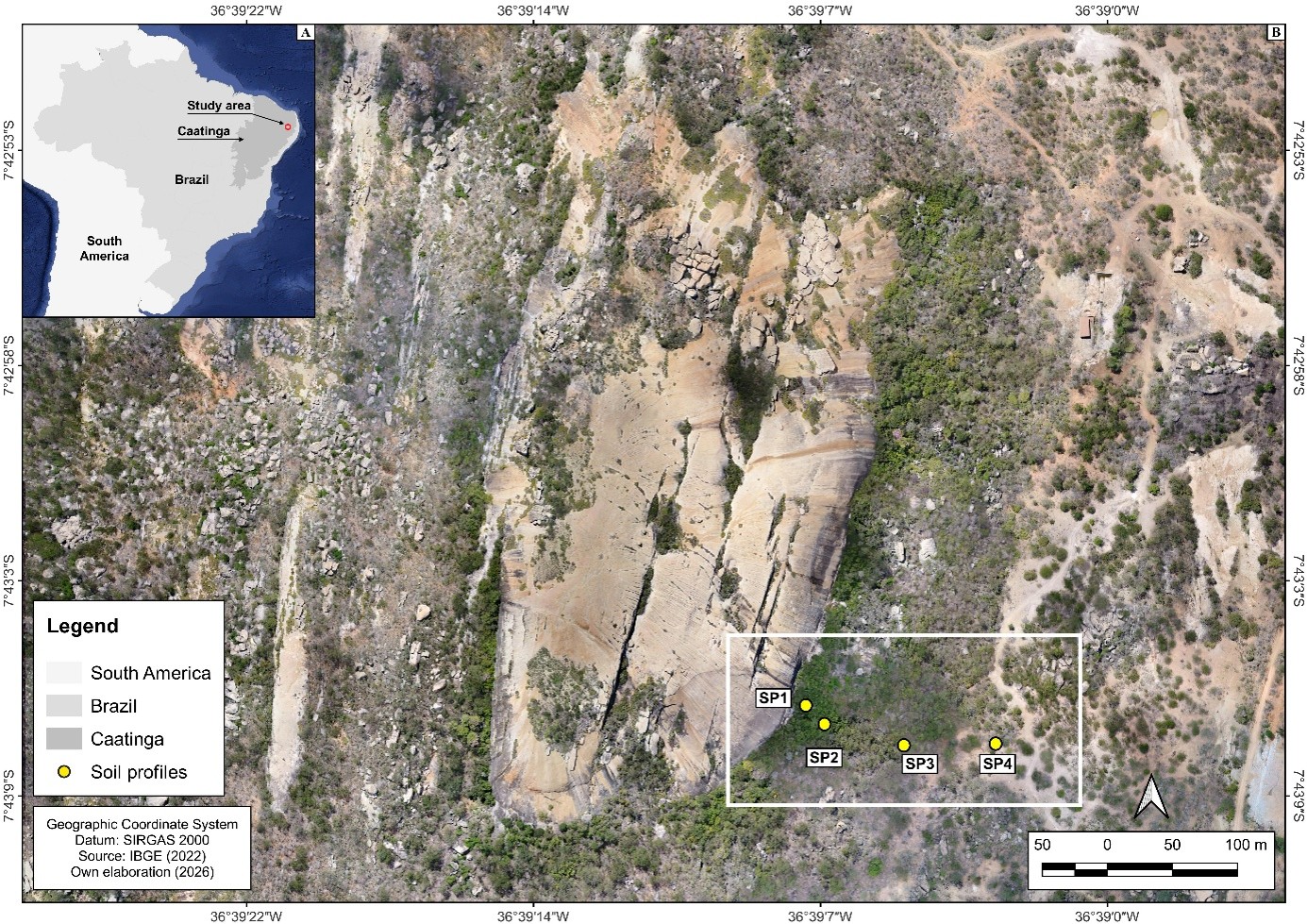
This study investigated a soil catena along a colluvial slope of a southeast-facing granitic inselberg to evaluate the influence of soil property variations on vegetation composition across altitudinal and distance gradients from the inselberg. Four soil profiles were described and sampled along a toposequence. Soil analyses included texture, acidity, exchangeable bases, phosphorus, nitrogen, and organic carbon contents. Total porosity, macroporosity, and microporosity were determined using undisturbed soil samples. Tree and shrub individuals were identified within vegetation plots around the soil profiles, and plant diversity and evenness were subsequently assessed. The toposequence comprised an Umbrisol (SP1), a Phaeozem (SP2), and two Regosols (SP3 e SP4), extending across different geomorphic positions (summit, shoulder, backslope and toeslope). Principal Component Analysis (PCA) and Spearman correlation were applied to assess the bivariate and multivariate relationships between soil, geomorphological, and vegetation variables. Results indicate that soil weathering intensity, leaching processes, and organic carbon contents increase with elevation and proximity to the inselberg. The higher organic carbon contents observed at the summit (C = 9.93% in SP1) and on the shoulder (C = 10.89% in SP2) of the colluvial slope are attributed to reduced accessibility of organic substrates to decomposers, coupled with intensified mineral-organic interactions, including sorption and chelation processes. Species from the Myrtaceae, Rubiaceae, Fabaceae, and Sapindaceae families were predominantly associated with soils rich in organic carbon, whereas species belonging to the Cactaceae and Euphorbiaceae families were more abundant in soils with lower organic carbon contents in the toeslope (SP4). Peripheral areas in inselbergs host more developed soils that support denser and structurally complex vegetation, functioning as ecological microrefugia relative to the surrounding Caatinga landscape. Overall, the findings of this study demonstrate that inselbergs can be considered essential environments for the conservation and maintenance of Caatinga biodiversity.
References
ALVARES, C. A.; STAPE, J. L.; SENTELHAS, P. C.; GONÇALVES, J. D. M.; SPAROVEK, G. Köppen’s climate classification map for Brazil. Meteorologische Zeitschrift, v. 22, p. 711–728, 2013. https://doi.org/10.1127/0941-2948/2013/0507
ALVAREZ, V. H.; NOVAIS, R. F.; CANTARUTTI, R. B.; TEIXEIRA, P. C.; CAMPOS, D. V. B. de. Fósforo remanescente. In: TEIXEIRA, P. C.; DONAGEMMA, G. K.; FONTANA, A.; TEIXEIRA, W. G. (Ed.) Manual de Métodos de Análise de Solo. 3ª edição revisada e ampliada. Brasília-DF: Embrapa, p. 337–342, 2017.
ANGIOSPERM PHYLOGENY GROUP (APG). An update of the angiosperm phylogeny group classification for the orders and families of flowering plants. Botanical Journal of the Linnean Society, v. 181, p. 1–20, 2016. https://doi.org/10.1111/boj.12385
ARAÚJO, E. L. Estresses abióticos e bióticos como forças modeladoras da dinâmica de populações vegetais da Caatinga. In: NOGUEIRA, R. J. M.; ARAÚJO, E. L.; WILLADINO, L. G.; CAVALCANTE, U. M. T. (Ed.). Estresses ambientais: danos e benefícios em plantas. Recife: MXM, p. 50–64, 2005.
ARAÚJO FILHO, J. C.; RIBEIRO, M. R.; BURGOS, N.; MARQUES, F. A. Solos da Caatinga. In: CURI, N.; KER, J. C.; NOVAIS, R. F.; VIDAL-TORRADO, P.; SCHAEFER, C. E. G. R. (Ed.). Pedologia: solos dos biomas brasileiros. Viçosa: Sociedade Brasileira de Ciência do Solo, p. 227–260, 2017.
BLAUD, A.; CHEVALLIER, T.; VIRTO, I.; PABLO, A. L.; CHENU, C.; BRAUMAN, A. Bacterial community structure in soil microaggregates and on particulate organic matter fractions located outside or inside soil macroaggregates. Pedobiologia, v. 57, p. 191–194, 2014. https://doi.org/10.1016/j.pedobi.2014.03.005
BOCALINI, F.; BOLÍVAR-LEGUIZAMÓN, S. D.; SILVEIRA, L. F.; BRAVO, G. A. Amazonian colonization from the Atlantic Forest: new perspectives on the connections of South American tropical forests. Molecular Ecology, v. 32, p. 6874–6895, 2023. https://doi.org/10.1111/mec.17180
BORGES NETO, I. O.; SANTOS, L. J. C.; SOUZA, J. J. L. L.; XAVIER, R. A.; SOUZA, B. I.; LIMA, V. R. P.; GOMES, A. S.; SEABRA, V. S.; CARDOSO, P. V. Soils formed in inselbergs host drought-sensitive species in the Brazilian semiarid. Pedosphere, 2025. https://doi.org/10.1016/j.pedsph.2025.09.028
BURKE, A. Inselbergs in a changing world: global trends. Diversity and Distributions, v. 9, p. 375–383, 2003. https://doi.org/10.1046/j.1472-4642.2003.00035.x
BURKE, A. Properties of soil pockets on arid Nama Karoo inselbergs–the effect of geology and derived landforms. Journal of Arid Environments, v. 50, n.2, p. 219–234, 2002. https://doi.org/10.1006/jare.2001.0907
CLARK-IOANNOU, S. M.; WARDELL-JOHNSON, G.W.; MILLETT, J. Multi-scale biogeographic controls over plant communities on granite outcrops in the Southwest Australian Floristic Region. Austral Ecology, v. 46, p. 627–639, 2021. https://doi.org/10.1111/aec.13018
CORDEIRO, J. M. P.; SOUZA, B. I.; SOUZA, A. F.; COSTA, A. I. S.; XAVIER, R. A.; RAMOS, U. S.; SOUZA, J. J. L. L. Are these islands isolated? Floristic diversity in inselberg habitats of the Caatinga, Northeastern Brazil. Biodiversity and Conservation, v. 34, p. 1–21, 2025. https://doi.org/10.1007/s10531-025-03065-2
CZARNES, S.; HALLETT, P. D.; BENGOUGH, A. G.; YOUNG, I. M. Root- and microbial-derived mucilages affect soil structure and water transport. European Journal of Soil Science, v. 51, p. 435–443, 2000. https://doi.org/10.1046/j.1365-2389.2000.00327.x
DE-BASHAN, L. E.; MAGALLON-SERVIN, P.; LOPEZ, B. R.; NANNIPIERI, P. Biological activities affect the dynamics of P in dryland soils. Biology and Fertility of Soils, v. 58, p. 105–119, 2022. https://doi.org/10.1007/s00374-021-01609-6
DONAGEMA, G. K.; CAMPOS, D. V. B.; CALDERANO, S. B.; TEIXEIRA, W. G.; VIANA, J. H. M. Manual de métodos de análise de solos. 2. ed. Rio de Janeiro: Embrapa Solos, 2011.
DUBUIS, A.; GIOVANETTINA, S.; PELLISSIER, L.; POTTIER, J.; VITTOZ, P.; GUISAN, A. Improving the prediction of plant species distribution and community composition by adding edaphic to topo-climatic variables. Journal of Vegetation Science, v. 24, p. 593–606, 2013. https://doi.org/10.1111/jvs.12002
ENRIGHT, N. J.; FONTAINE, J. B.; LAMONT, B. B.; MILLER, B. P.; WESTCOTT, V. C. Resistance and resilience to changing climate and fire regime depend on plant functional traits. Journal of Ecology, v. 102, p. 1572–1581, 2014. https://doi.org/10.1111/1365-2745.12306
ERKTAN, A.; BALMOT, J.; MERINO-MARTÍN, L.; MONNIER, Y.; PAILLER, F.; COQ, S.; ABIVEN, S.; STOKES, A.; LE BISSONNAIS, Y. Immediate and long-term effect of tannins on the stabilization of soil aggregates. Soil Biology and Biochemistry, v. 105, p. 197–205, 2017. https://doi.org/10.1016/j.soilbio.2016.11.017
FERNANDES, M. F.; CARDOSO, D.; QUEIROZ, L. P. An updated plant checklist of the Brazilian Caatinga seasonally dry forests and woodlands reveals high species richness and endemism. Journal of Arid Environments, v. 174, p. 104079, 2020. https://doi.org/10.1016/j.jaridenv.2019.104079
FERREIRA, C. R. P. C.; ANTONINO, A. C. D.; SAMPAIO, E. V. S. B.; CORREIA, K. G.; LIMA, J. R. S.; SOARES, W. A.; MENEZES, R. S. C. Soil CO₂ efflux measurements by alkali absorption and infrared gas analyzer in the Brazilian semiarid region. Revista Brasileira de Ciência do Solo, v. 42, p. e0160563, 2018. https://doi.org/10.1590/18069657rbcs20160563
FIDALGO, E. C. C.; BENITES, V. de M.; MACHADO, P. L. O. de A.; MADARI, B. E.; COELHO, M. R.; MOURA, I. B. de; LIMA, C. X. de. Estoques de carbono nos solos do Brasil. Rio de Janeiro: Embrapa Solos. Boletim de pesquisa e desenvolvimento, 121, 2007, 26p. Available: http://www.infoteca.cnptia.embrapa.br/infoteca/handle/doc/339464. Accessed on: feb. 17, 2026.
GOMES, A. S.; BORGES NETO, I. de O.; PEDRO-SILVA, L.; RODRIGUES, E. de M.; VIEIRA, C. S.; LOPES, S. de F.; SOUZA, J. J. L. L. de. Soil organic carbon distribution in inselbergs of Caatinga. Geoderma Regional, v. 46, e01128, 2026. https://doi.org/10.1016/j.geodrs.2026.e01128
HINTON, P. R. Statistics Explained. Routledge, 2014. https://doi.org/10.4324/9781315797564
HUSTON, M. A. Disturbance, productivity, and species diversity: empiricism vs. logic in ecological theory. Ecology, v. 95, p. 2382–2396, 2014. https://doi.org/10.1890/13-1397.1
IUSS WORKING GROUP WRB. World Reference Base for Soil Resources 2022: international soil classification system for naming soils and creating legends for soil maps. Rome: FAO, 2022. (World Soil Resources Reports).
KANG, S.-H.; CHOI, W. Oxidative degradation of organic compounds using zero-valent iron in the presence of natural organic matter serving as an electron shuttle. Environmental Science & Technology, v. 43, p. 878–883, 2009. https://doi.org/10.1021/es801705f
MACHADO, A. F.; SILVA, M. N. F.; FARIAS, I. P.; ANCIÃES, M.; NUNES, M. S.; PEÇANHA, W. T.; RITTER, C. D.; AZEVEDO, J. A. R.; MIRANDA, C. L.; DUARTE, L. Recent past connections between Amazonian and Atlantic forests by comparative phylogeography and paleodistribution models for didelphid mammals. Evolutionary Ecology, v. 38, p. 23, 2024. https://doi.org/10.1007/s10682-024-10292-6
MAGNAGO, L. F. S.; MARTINS, S. V.; SCHAEFER, C. E. G. R.; NERI, A. V. Restinga forests of the Brazilian coast: richness and abundance of tree species on different soils. Anais da Academia Brasileira de Ciências, v. 84, p. 807–822, 2012. https://doi.org/10.1590/S0001-37652012000300023
MEDINSKI, T. V.; MILLS, A. J.; ESLER, K. J.; SCHMIEDEL, U.; JÜRGENS, N. Do soil properties constrain species richness? Insights from boundary line analysis across several biomes in southwestern Africa. Journal of Arid Environments, v. 74, p. 1052–1060, 2010. https://doi.org/10.1016/j.jaridenv.2010.03.004
MINICK, K. J.; FISK, M. C.; GROFFMAN, P. M. Soil Ca alters processes contributing to C and N retention in the Oa/A horizon of a northern hardwood forest. Biogeochemistry, v. 132, p. 343–357, 2017. https://doi.org/10.1007/s10533-017-0307-z
MORO, M. F.; AMORIM, V. O.; QUEIROZ, L. P.; COSTA, L. R. F.; MAIA, R. P.; TAYLOR, N. P.; ZAPPI, D. C. Biogeographical districts of the Caatinga dominion: a proposal based on geomorphology and endemism. The Botanical Review, v. 90, p. 376–429, 2024. https://doi.org/10.1007/s12229-024-09304-5
MORO, M. F.; LUGHADHA, E. N.; ARAÚJO, F. S.; MARTINS, F. R. A phytogeographical metaanalysis of the semiarid Caatinga domain in Brazil. The Botanical Review, v. 82, p. 91–148, 2016. https://doi.org/10.1007/s12229-016-9164-z
PALOSCHI, R. A.; RAMOS, D. M.; VENTURA, D. J.; SOUZA, R.; SOUZA, E.; MORELLATO, L. P. C.; NÓBREGA, R. L. B.; COUTINHO, Í. A. C.; VERHOEF, A.; KÖRTING, T. S.; BORMA, L. S. Environmental drivers of water use for Caatinga woody plant species: combining remote sensing phenology and sap flow measurements. Remote Sensing, v. 13, p. 75, 2021. https://doi.org/10.3390/rs13010075
PARMENTIER, I.; STÉVART, T.; HARDY, O. J. The inselberg flora of Atlantic Central Africa. I. Determinants of species assemblages. Journal of Biogeography, v. 32, p. 685–696, 2005. https://doi.org/10.1111/j.1365-2699.2004.01243.x
PATTON, N. R.; LOHSE, K. A.; SEYFRIED, M. S.; GODSEY, S. E.; PARSONS, S. B. Topographic controls of soil organic carbon on soil-mantled landscapes. Scientific Reports, v. 9, p. 6390, 2019. https://doi.org/10.1038/s41598-019-42556-5
PÉREZ, F. L. Geoecology of a granite dome: Spatial interactions between gnammas, rills, soils, and plant cover, Enchanted Rock (Texas, USA). Catena, v. 223, 106938, 2023. https://doi.org/10.1016/j.catena.2023.106938
PINTO-JUNIOR, H. V.; HERINGER, G.; DINIZ, É. S.; MÜLLER, L. A. C.; VILLA, P. M.; MEIRA-NETO, J. A. A.; NERI, A. V. Biogeographic isolation and climate shape the evolutionary heritage of Neotropical inselbergs. Global Ecology and Biogeography, v. 33, p. e13860, 2024. https://doi.org/10.1111/geb.13860
POREMBSKI, S.; SEINE, R.; BARTHLOTT, W. Factors controlling species richness of inselbergs. In: POREMBSKI, S.; BARTHLOTT, W. (Ed.). Inselbergs. Berlin: Springer, (Ecological Studies). p. 451–481, 2000. https://doi.org/10.1007/978-3-642-59773-2_21
R CORE TEAM. R: a language and environment for statistical computing. Vienna: R Foundation for Statistical Computing, 2020.
REICHMANN, L. G.; SALA, O. E.; PETERS, D. P. C. Water controls on nitrogen transformations and stocks in an arid ecosystem. Ecosphere, v. 4, p. 1–17, 2013. https://doi.org/10.1890/ES12-00263.1
RIBEIRO, E. M. S.; ARROYO-RODRIGUEZ, V.; SANTOS, B. A.; TABARELLI, M.; LEAL, I. R. Chronic anthropogenic disturbance drives the biological impoverishment of the Brazilian Caatinga. Journal of Applied Ecology, v. 52, p. 611–620, 2015. https://doi.org/10.1111/1365-2664.12420
RIBEIRO, E. M. S.; SANTOS, B. A.; ARROYO-RODRIGUEZ, V.; TABARELLI, M.; LEAL, I. R. Phylogenetic impoverishment of plant communities following chronic human disturbances in the Brazilian Caatinga. Ecology, v. 97, p. 1583–1592, 2016. https://doi.org/10.1890/15-1122.1
RODRIGUES, P. M. S.; SCHAEFER, C. E. G. R.; OLIVEIRA SILVA, J.; FERREIRA, W. G.; SANTOS, R. M.; NERI, A. V. The influence of soil on vegetation structure and plant diversity in different tropical savannic and forest habitats. Journal of Plant Ecology, v. 11, p. 226–236, 2018. https://doi.org/10.1093/jpe/rtw135
ROWLEY, M. C.; GRAND, S.; VERRECCHIA, É. P. Calcium-mediated stabilisation of soil organic carbon. Biogeochemistry, v. 137, p. 27–49, 2018. https://doi.org/10.1007/s10533-017-0410-1
SALGADO, A. A. R.; BUENO, G. T.; DINIZ, A. D.; MARENT, B. R. Long-term geomorphological evolution of the Brazilian territory. In: VIEIRA, B. C.; SALGADO, A. A. R.; SANTOS, L. J. C. (Ed.). Landscapes and landforms of Brazil. Dordrecht: Springer, p. 19–31, 2015.
https://doi.org/10.1007/978-94-017-8023-0_3
SANTOS, H. G.; CARVALHO JUNIOR, W.; DART, R. O.; AGLIO, M. L. D.; SOUZA, J. S.; PARES, J. G.; FONTANA, A.; MARTINS, A. L. S.; OLIVEIRA, A. P. O novo mapa de solos do Brasil: legenda atualizada. Rio de Janeiro: Embrapa Solos, 2011.
SANTOS, H. G.; JACOMINE, P. K. T.; ANJOS, L. H. C.; OLIVEIRA, V. A.; LUMBRERAS, J. F.; COELHO, M. R.; ALMEIDA, J. A.; ARAÚJO FILHO, J. C.; OLIVEIRA, J. B.; CUNHA, T. J. F. Sistema brasileiro de classificação de solos. 6. ed. Brasília: Embrapa, 2025.
SEILER, C.; HUTJES, R. W. A.; KRUIJT, B.; HICKLER, T. The sensitivity of wet and dry tropical forests to climate change in Bolivia. Journal of Geophysical Research: Biogeosciences, v. 120, p. 399–413, 2015. https://doi.org/10.1002/2014JG002749
SEINE, R.; POREMBSKI, S.; BECKER, U. Phytogeography. In: POREMBSKI, S.; BARTHLOTT, W. (Ed.). Inselbergs: biotic diversity of isolated rock outcrops in tropical and temperate regions. Berlin: Springer, p. 435–450, 2000.
https://doi.org/10.1007/978-3-642-59773-2_20.
SILVA, Y. J. A. B. da; NASCIMENTO, C. W. A. do; BIONDI, C. M.; VAN STRAATEN, P.; SOUZA JÚNIOR, V. S. de; FERREIRA, T. O. Geochemical signatures and weathering rates in soils derived from different granites in contrasting climatic locations. Acta Scientiarum Agronomy, [S. l.], v. 41, n. 1, p. e39708, 2018. https://doi.org/10.4025/actasciagron.v41i1.39708
SOBRAL-SOUZA, T.; LIMA-RIBEIRO, M. S.; SOLFERINI, V. N. Biogeography of Neotropical rainforests: past connections between Amazon and Atlantic Forest detected by ecological niche modeling. Evolutionary Ecology, v. 29, p. 643–655, 2015. https://doi.org/10.1007/s10682-015-9780-9
SOUZA, B. I.; LUNGUINHO, R. L.; XAVIER, R. A.; QUEIROZ, R. T. D.; MEDEIROS, J. R. D.; CARDOSO, E. C. M.; MACIEL, M. G. R.; BORGES NETO, I. O.; SANTOS, L. J. C.; SOUZA, J. J. L. L.; CORDEIRO, J. M. P. Rainwater runoff, soil, and vegetation interactions in inselbergs provide microrefugia in Brazil's Caatinga drylands. Environmental Monitoring and Assessment, v. 197, p. 772, 2025. https://doi.org/10.1007/s10661-025-14192-2
SOUZA, J. J. L. L.; FONTES, M. P. F.; GILKES, R.; COSTA, L. M.; OLIVEIRA, T. S. Geochemical signature of Amazon tropical rainforest soils. Revista Brasileira de Ciência do Solo, v. 42, p. e0170192, 2018. https://doi.org/10.1590/18069657rbcs20170192
SOUZA, J. J. L. L.; SOUZA, B. I.; XAVIER, R. A.; CARDOSO, E. C. M.; MEDEIROS, J. R.; FONSECA, C. F.; SCHAEFER, C. E. G. R. Organic carbon-rich soils in the Brazilian semiarid region and paleoenvironmental implications. Catena, v. 212, p. 106101, 2022. https://doi.org/10.1016/j.catena.2022.106101
TANG, J.; MO, Y.; ZHANG, J.; ZHANG, R. Influence of biological aggregating agents associated with microbial population on soil aggregate stability. Applied Soil Ecology, v. 47, p. 153–159, 2011. https://doi.org/10.1016/j.apsoil.2011.01.001
TEIXEIRA, P. C.; DONAGEMA, G. K.; FONTANA, A.; TEIXEIRA, W. G. Manual de métodos de análise de solos. Brasília: Embrapa, 2017.
TINDANO, E.; KADÉBA, A.; TRAORÉ, I. C. E.; THIOMBIANO, A. Effects of abiotic factors on the flora and vegetation of inselbergs in Burkina Faso. Environmental Advances, v. 12, p. 100378, 2023. https://doi.org/10.1016/j.envadv.2023.100378
VAN DER PUTTEN, W. H.; BARDGETT, R. D.; BEVER, J. D.; BEZEMER, T. M.; CASPER, B. B.; FUKAMI, T.; KARDOL, P.; KLIRONOMOS, J. N.; KULMATISKI, A.; SCHWEITZER, J. A.; SUDING, K. N.; VAN DE VOORDE, T. F. J.; WARDLE, D. A. Plant–soil feedbacks: the past, the present and future challenges. Journal of Ecology, v. 101, p. 265–276, 2013. https://doi.org/10.1111/1365-2745.12054
WANG, X.; AULER, A. S.; EDWARDS, R. L.; CHENG, H.; CRISTALLI, P. S.; SMART, P. L.; RICHARDS, D. A.; SHEN, C.-C. Wet periods in northeastern Brazil over the past 210 kyr linked to distant climate anomalies. Nature, v. 432, p. 740–743, 2004. https://doi.org/10.1038/nature03067
WERNECK, F. P.; COSTA, G. C.; COLLI, G. R.; PRADO, D. E.; SITES JUNIOR, J. W. Revisiting the historical distribution of seasonally dry tropical forests: new insights based on palaeodistribution modelling and palynological evidence. Global Ecology and Biogeography, v. 20, p. 272–288, 2011. https://doi.org/10.1111/j.1466-8238.2010.00596.x
WRIGHT, C. L.; WEST, J. B.; LIMA, A. L.; SOUZA, E. S.; MEDEIROS, M.; WILCOX, B. P. Contrasting water-use strategies revealed by species-specific transpiration dynamics in the Caatinga dry forest. Tree Physiology, v. 44, p. tpad137, 2024. https://doi.org/10.1093/treephys/tpad137
XAVIER, R. A.; SOUZA, B. I.; CARDOSO, E. C. M.; SILVA SEABRA, V. Padrões de relevo da Área de Proteção Ambiental do Cariri Paraibano: uma contribuição à cartografia geomorfológica semiárida. Revista Ciência Geográfica, v. 26, p. 34–50, 2022. https://doi.org/10.18817/26755122.26.01.2022.2866
YEOMANS, J. C.; BREMNER, J. M. A rapid and precise method for routine determination of organic carbon in soil. Communications in Soil Science and Plant Analysis, v. 19, p. 1467–1476, 1988. https://doi.org/10.1080/00103628809368027
ZAR, J. H. Spearman Rank Correlation: Overview. In: BALAKRISHNAN, N.; COLTON, T.; EVERITT, B.; PIEGORSCH, W.; RUGGERI, F.; TEUGELS, J. L. (Ed.). Wiley StatsRef: Statistics Reference Online. Chichester: John Wiley & Sons, 2014. Accessed on: 27 Feb. 2026. https://doi.org/10.1002/9781118445112.stat05964
ZINCK, J. A. The Geomorphic Landscape: Classification of Geoforms. In: ZINCK, J. A.; METTERNICHT, G.; DEL VALLE, H. F.; ANGELINI, M. (Ed.). Geopedology: an integration of geomorphology and pedology for soil and landscape studies. Springer, p. 107–131, 2023. https://doi.org/10.1007/978-3-031-20667-2_7

This work is licensed under a Creative Commons Attribution 4.0 International License.
Copyright (c) 2025 Bartolomeu Israel de Souza, Rony Lopes Lunguinho, Daniel Kroehling, José João Lelis Leal de Souza, Rubens Teixeira de Queiroz, Joseilsom Ramos de Medeiros, Eini Celly Morais Cardoso, Joel Maciel Pereira Cordeiro, Rafael Albuquerque Xavier, Inocencio de Oliveira Borges Neto