
Keywords
Dark Ecological Network
Urban Landscape
Light Pollution
Rio de Janeiro
How to Cite




Abstract
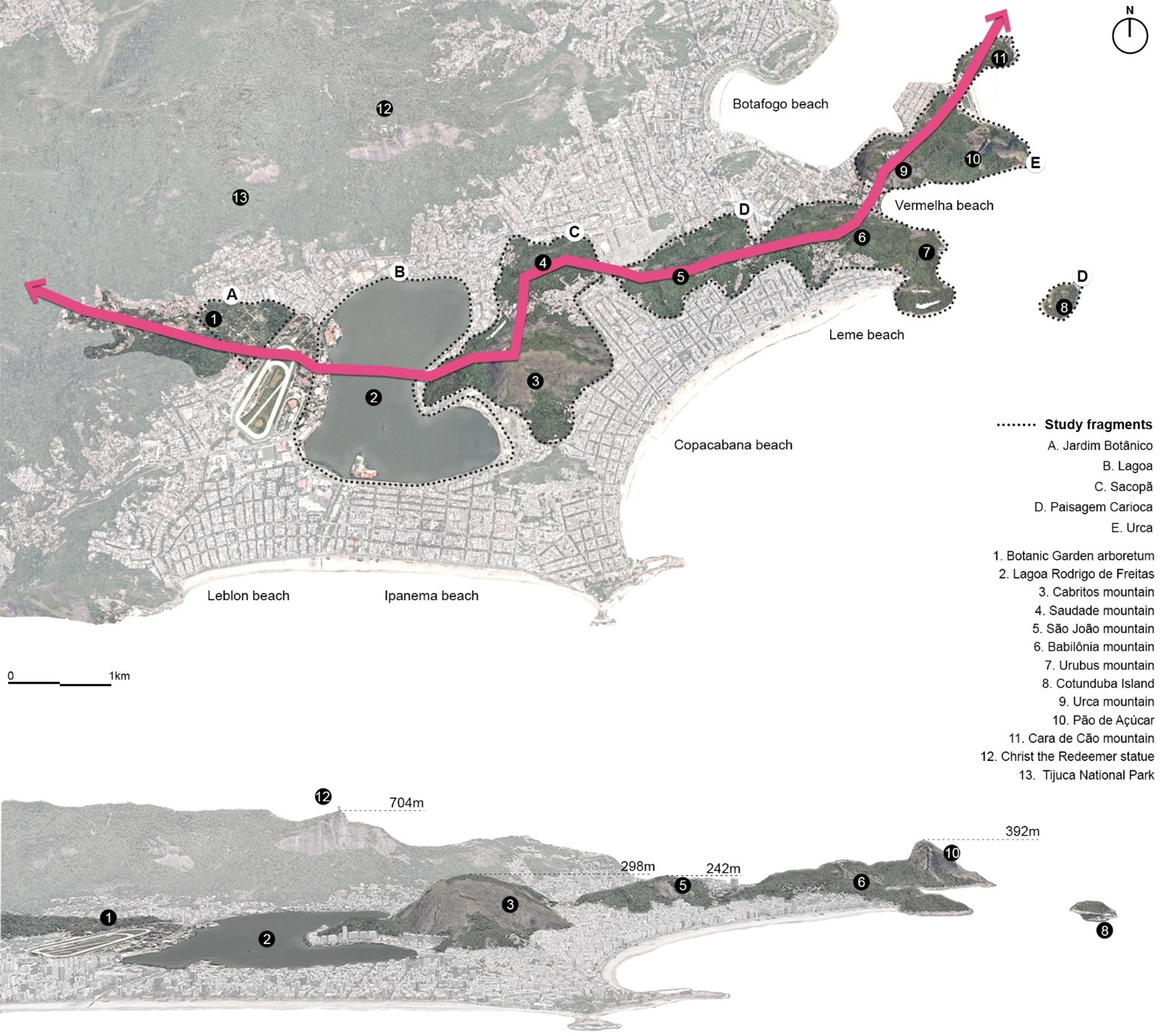
The nocturnal landscapes host unique fauna and flora dynamics, sheltering camouflaged natural processes that have been insufficiently acknowledged in city planning and design. Recent urban studies have pointed out that urban lighting can fragment the nocturnal habitat, demanding new guidelines and strategies in urban lighting design. This paper aims to explore design and planning potentialities that support nocturnal landscape biodiversity, looking at interrelationships between ecological and sociocultural dimensions of the urban landscape. Drawing on a case study in the city of Rio de Janeiro—in an area between the mountains and the sea—this paper uses cartography as an interdisciplinary approach to analyze the nocturnal urban biodiversity, brightness and explores possibilities for nocturnal urban planning. Cartography was a catalyst for implementing methods such as fieldwork, mapping, interviews and bibliographic research, gathering data from different fields, mainly between urbanism and ecology. The article results reveal the existing nocturnal biodiversity in the study area and its environmental sensitivity, exploring mediations between urban lighting and the landscape’s ecological and sociocultural dimensions. From the findings, the paper suggests preliminary guidelines for planning nighttime environments more sustainably through green–blue landscape networks. This paper seeks to integrate the nocturnal landscape into the urban agenda, expanding the debate on urban biodiversity and open spaces.
References
ALVES, M. A.; PEREIRA, E. F. Richness, abundance and seasonality of birds species in a lagoon of an urban area (Lagoa Rodrigo de Freitas) of Rio de Janeiro, Brazil. Ararajuba, v. 6, n. 2, p. 110–116, 1998.
BENEDICT, M. A.; MCMAHON, E. Green Infrastructure: Linking Landscapes and Communities. Washington, DC: Island Press, 2006.
BESSE, J. La nécessité du paysage. Marseille: Éditions Parenthèses, 2018.
BERGALLO, H. de G.; ROCHA, C. F.; ALVES, M. A. dos S.; M. V. S. (Orgs.). A fauna ameaçada de extinção do Estado do Rio de Janeiro. Rio de Janeiro: EdUERJ, 2000.
BERGER, C.; QUADU, F. Le projet INTERREG VI LUNÉfil: Réflexions et pistes pour la mise en œuvre d’une trame noire transfrontalière répondant aux enjeux de transition énergétique et écologique. lieuxdits, n. 27, p. 16–21, https://doi.org/10.14428/ld.vi27.87933
CASSIMIRO, I. M. F.; RIBEIRO, M. C.; ASSIS, J. C. How did the animal come to cross the road? Drawing insights on animal movement from existing roadkill data and expert knowledge. Landscape Ecology, v. 38, n. 8, p. 2035–2051, 2023. https://doi.org/10.1007/s10980-023-01671-5
CARVALHO, N. M. Ambiências noturnas: Arquiteturas e Subjetividades em Cenários Urbanos Cariocas. Thesis (Master degree in Architecture). Universidade Federal do Rio de Janeiro, Programa de Pós-graduação em Arquitetura – PROARQ, 2013.
CHALLÉAT, S. Le socioécosystème environnement nocturne: un objet de recherche interdisciplinaire. Natures Sciences Sociétés, v. 26, n. 3, p. 257–269, 2018. https://doi.org/10.1051/nss/2018042
CHALLÉAT, S.; BARRÉ, K.; LAFORGE, A.; LAPOSTOLLE, D.; FRANCHOMME, M.; SIRAMI, C.; LE VIOL, I.; MILIAN, J.; KERBIRIOU, C. Grasping darkness: the dark ecological network as a social-ecological framework to limit the impacts of light pollution on biodiversity. Ecology and Society, v. 26, n. 1, 2021. https://doi.org/10.5751/ES-12156-260115
CNC FLORA. Centro Nacional de Conservação da Flora. Lista Vermelha da flora brasileira versão 2012, JBRJ. 2012. Available: http://cncflora.jbrj.gov.br/portal/pt-br/listavermelha. Accessed on: jan. 28, 2024.
CORNER, J. Representation and landscape: Drawing and making in the landscape medium. Word & Image, v. 8, n. 3, p. 243–275, 1992. https://doi.org/10.1080/02666286.1992.10435840
CORNER, J. The Agency of Mapping: Speculation, Critique and Invention. In: COSGROVE, D. (Org.). Mappings. London: Reaktion Books, p. 212–252, 1999a.
CORNER, J. Eidetic operations and new landscapes. In: CORNER, J. (Org.). Recovering Landscape: Essays in Contemporary Landscape Theory. New York: Princeton Architectural Press, p. 153–170, 1999b.
CORNER, J. Terra Fluxus. In: WALDHEIM, C. (Org.). The Landscape Urbanism Reader. New York: Princeton Architectural Press, p. 21–34, 2006.
COSGROVE, D. (Org.). Mappings. London: Reaktion Books, 1999.
FARINHA-MARQUES, P.; FERNANDES, C.; GUILHERME, F.; LAMEIRAS, J. M.; ALVES, P.; BUNCE, R. Morfologia e Biodiversidade nos Espaços Verdes da Cidade do Porto, livro I - Seleção das áreas de estudo. 2. ed. Porto: CIBIO | Centro de Investigação em Biodiversidade e Recursos Genéticos, 2014.
FARINHA-MARQUES, P.; FERNANDES, C.; CÉLIO, P.; GONÇALVES, C.; GUILHERME, F. Suporte Biofísico e Ambiente, Estrutura Ecológica e Biodiversidade - Relatório de Caraterização e Diagnóstico. Porto: Câmara Municipal do Porto, 2017.
FERREIRA, T. de A. Cidade noturna: diálogos entre Biodiversidade, Noite e Paisagem. Thesis (Doctorate in Urbanism) - Rio de Janeiro: Universidade Federal do Rio de Janeiro, PROURB-UFRJ, 2024. Available: http://objdig.ufrj.br/21/teses/950233.pdf. Accessed on: apr. 03, 2026.
FERREIRA, T. de A. O desenho da paisagem noturna do Rio de Janeiro: inter-relações e dissensos entre valores socioculturais e ambientais (1850-2000). CIDADES, Comunidades e Territórios, n. 51, p. 1-19, 2026. https://doi.org/10.15847/cct.38627
FLORA E FUNGA DO BRASIL. Jardim Botânico do Rio de Janeiro. 2023. Available: http://floradobrasil.jbrj.gov.br/. Accessed on: jan. 27, 2023.
GALINDO-LEAL, C.; CÂMARA, I. de G. (Orgs.). Mata Atlântica: biodiversidade, ameaças e perspectivas. Belo Horizonte: Fundação SOS Mata Atlântica, Conservação Internacional, 2005.
GASTON, K. J.; DAVIES, T. W.; BENNIE, J.; HOPKINS, J. Reducing the ecological consequences of night-time light pollution: options and developments. Journal of Applied Ecology, v. 49, n. 6, p. 1256–1266, 2012. https://doi.org/10.1111/j.1365-2664.2012.02212.x
GAUTHREAUX, S. A.; BELSER, C. G. Effects of artificial night lighting on migrating birds. In: RICH, C.; LONGCORE, T. (Orgs.). Ecological Consequences of Artificial Night Lighting. Washington, DC: Island Press, 2006. p. 67–93.
GÓIS, M. P. F. A gestão da noite urbana carioca: entre discursos sobre ordem urbana e práticas socioeconômicas. Sociedade & Natureza, v. 26, n. 2, p. 221–235, 2014. https://doi.org/10.1590/1982-451320140202
GUDYNAS, E. Derechos de la naturaleza: ética biocéntrica y políticas ambientales. Lima: Programa Democracia y Transformación Global, 2014.
HÖLKER, F.; BOLLIGER, J.; DAVIES, T.; GIAVI, S.; JECHOW, A.; KALINKAT, G.; LONGCORE, T.; SPOELSTRA, K.; TIDAU, S.; VISSER, M.; KNOPP, E. 11 pressing research questions on how light pollution affects biodiversity. Frontiers in Ecology and Evolution, p. 1–13, 2021. https://doi.org/10.3389/fevo.2021.767177
HOUGH, M. Cities and Natural Process. London: Routledge, 1995.
https://doi.org/10.4324/9780203292433
IPP. INSTITUTO PEREIRA PASSOS. DATA.Rio, informações sobre a cidade. 2021. Available: https://www.data.rio/. Accessed on: aug. 19, 2024.
IUCN. International Union for Conservation of Nature and Natural Resources. The IUCN Red List of Threatened Species. 2023. Available: https://www.iucnredlist.org/en. Accessed on: 19 out. 2023.
JOKIMÄKI, J.; KAISANLAHTI-JOKIMÄKI, M.; SUHONEN, J.; CLERGEAU, P.; PAUTASSO, M.; FERNÁNDEZ-JURICIC, E. Merging wildlife community ecology with animal behavioral ecology for a better urban landscape planning. Landscape and Urban Planning, Landscape and Urban Planning at 100. v. 100, n. 4, p. 383–385, 2011. https://doi.org/10.1016/j.landurbplan.2011.02.001
JORNAL DO BRASIL. Mariposa é problema do Corcovado, p. 12, 9 jun. 1973. Available: http://memoria.bn.br/DocReader/030015_09/11311. Accessed on: jun. 17, 2021.
KALKO, E.; HANDLEY, C. O.; HANDLEY, D. Organization, Diversity, and Long-Term Dynamics of a Neotropical Bat Community. In: CODY, M. L.; SMALLWOOD, J. A. (Orgs.). Long-Term Studies of Vertebrate Communities. San Diego; London: Academic Press, p. 503–553, 1996.
https://doi.org/10.1016/B978-012178075-3/50017-9
MOURA, A. S. de; SOUZA, D. B. de; MACHADO, F. S.; MENGEZ, U. C. L.; LEITE, L. H.; MARIANO, R., F.; FONTES, M. A. L. Aves de hábitos noturnos e crepusculares de áreas com grande biodiversidade no sul de Minas Gerais. Atualidades Ornitológicas, n. 215, p. 67–73, 2020.
PACHECO, J. F.; SILVEIRA, L. F.; ALEIXO, A., AGNE, C. E., BENCKE, G. A.; BRAVO, G. A.; BRITO, G. R. R.; COHN-HAFT, M.; MAURÍCIO, G. N.; NAKA, L. N.; OLMOS, F., POSSO, S. R.; LEES, A. C.; FIGUEIREDO, L. F. A.; CARRANO, E.; GUEDES, R. C.; CESARI, E.; FRANZ, I.; SCHUNCK, F.; PIACENTINI, V de Q. Annotated checklist of the birds of Brazil by the Brazilian Ornithological Records Committee – second edition. Ornithology Research, v. 29, n. 2, p. 94–105, 2021. https://doi.org/10.1007/s43388-021-00058-x
PAGLIA, A. P.; FONSECA, G. A. B.; RYLANDS, A. B.; HERRMANN, G.; AGUIAR, L. M. S.; CHIARELLO, A. G.; LEITE, Y. L. R.; COSTA, L. P.; SICILIANO, S.; KIERULFF, M. C. M.; MENDES, S. L.; TAVARES, V. da C.; MITTERMEIER, R. A.; PATTON, J. L. Lista anotada dos mamíferos do Brasil (2a edição). Occasional Papers in Conservation Biology, Conservation International, Arlington, VA. n. 6, p. 1–76, 2012.
PEREIRA, A. D.; BASTIANI, E. de; BAZILIO, S. Influência do ciclo lunar no padrão de atividade de Cuniculus Paca (Rodentia: Cuniculidae) em uma floresta de Mata Atlântica no Sul do Brasil. Papéis Avulsos de Zoologia, v. 56, p. 97–102, 2016. https://doi.org/10.1590/0031-1049.2016.56.08
PEREIRA, R. C.; ROQUE, F. de O.; CONSTANTINO, P. de A.; SABINO, J.; UEHARA-PRADO, M. Monitoramento in situ da biodiversidade: Proposta para um Sistema Brasileiro de Monitoramento da Biodiversidade. Brasília: ICMBio, 2013.
PIRES, D. P. de S.; CADEMARTORI, C. V. Influence of the size and degree of conservation of remnants of the Atlantic rain forest on chiropteran assemblages. Acta Biológica Catarinense, v. 5, n. 2, p. 68–79, 2018. https://doi.org/10.21726/abc.v5i2.302
QGIS. QGIS Geographic Information System. Version 3.30.2. QGIS Zenodo Landing Page, 2023. https://doi.org/10.5281/zenodo.7986782
QUINTELA, F.M.; DA ROSA, C. A.; FEIJÓ, A. Updated and annotated checklist of recent mammals from Brazil. Anais da Academia Brasileira de Ciências, v. 92, 2020. https://doi.org/10.1590/0001-3765202020191004
REIS, N. R. dos; PERACCHI, A. L.; PEDRO, W. A.; LIMA, I. P. (Orgs.). Morcegos do Brasil. Londrina: Nelio R. dos Reis, 2007.
REIS, N. R. dos; PERACCHI, A. L.; PEDRO, W. A.; LIMA, I. P. (Orgs.). Mamíferos do Brasil. 2. ed. Londrina: Technical Books, 2011.
REIS, L. D. E. A luz artificial à noite em parques urbanos afeta os morcegos ou as presas de morcegos? Master Thesis (Master degree in Ecology) - Universidade de Brasília, Programa de Pós-graduação em Ecologia, 2019.
RIOS, E.; BENCHIMOL, M.; DE VLEESCHOUWER; K.; CAZETTA, E. Spatial predictors and species’ traits: evaluating what really matters for medium-sized and large mammals in the Atlantic Forest, Brazil. Mammal Review, v. 52, n. 2, p. 236–251, 2022. https://doi.org/10.1111/mam.12276
RYDELL, J. Bats and their insect prey at streetlights. In: RICH, C.; LONGCORE, T. (Orgs.). Ecological Consequences of Artificial Night Lighting. Washington: Island Press, p. 43–60, 2006.
SAVARD, J. L.; CLERGEAU, P.; MENNECHEZ, G. Biodiversity concepts and urban ecosystems. Landscape and Urban Planning, v. 48, n. 3, p. 131–142, 2000. https://doi.org/10.1016/S0169-2046(00)00037-2
SICK, H. Ornitologia brasileira. 3. ed. Rio de Janeiro: Nova Fronteira, 2001 [1997].
SMAC, Secretaria Municipal do Ambiente e Clima da Cidade do Rio de Janeiro. Resolução SMAC nº 074, de 19 de Agosto de 2022. 2022a. Available: https://doweb.rio.rj.gov.br/portal/visualizacoes/pdf/5436/#/p:1/e:5436. Accessed on: dec. 22, 2025.
SMAC, Secretaria Municipal do Ambiente e Clima da Cidade do Rio de Janeiro. Resolução SMAC nº 073, de 19 de Agosto de 2022. 2022b. Available at: https://doweb.rio.rj.gov.br/portal/visualizacoes/pdf/5436/#/p:1/e:5436. Accessed on: dec. 22, 2025.
SORDELLO, R.; AZAM, C.; AMSALLEM, J.; BAS, Y.; BILLON, L.; BUSSON, S.; CHALLÉAT, S.; CHRISTIAN, K.; LE VIOL, I. Construire des indicateurs nationaux sur la pollution lumineuse. Paris: UMS PatriNat, Cerema, CESCO, DarkSkyLab, IRD, Irstea, 2018. Available: https://www.trameverteetbleue.fr/documentation/references-bibliographiques/construire-indicateurs-nationaux-sur-pollution-lumineuse. Accessed on: dec. 22, 2025.
SORDELLO, R.; BUSSON, S.; CORNUAU, J. H.; DEVERCHÈRE, P.; FAURE, B.; GUETTÉ, A.; HÖLKER, F.; KERBIRIOU, C.; LENGAGNE, T.; LE VIOL, I.; LONGCORE, T.; MOESCHLER, P.; RANZONI, J.; RAY, N.; REYJOL, Y.; ROULET, Y.; SCHROER, S.; SECONDI, J.; VALET, N.; VANPEENE, S.; VAUCLAIR, S. A plea for a worldwide development of dark infrastructure for biodiversity – Practical examples and ways to go forward. Landscape and Urban Planning, v. 219, p. 104332, 2021. https://doi.org/10.1016/j.landurbplan.2021.104332
STARE, J.; KYBA, C. Radiance Light Trends. GFZ Data Services, 2019. https://doi.org/10.5880/GFZ.1.4.2019.001
STOTZ, D. F.; FITZPATRICK, J. W., III PARKER, MOSKOVITS, D. K. (Orgs.). Neotropical Birds: Ecology and Conservation. Chicago, London: University of Chicago Press, 1996.
TOMPSON, L.; STEINBACH, R.; JOHNSON, S. D.; TEH, C. S.; PERKINS, C.; EDWARDS, P.; ARMSTRONG, B. Absence of Street Lighting May Prevent Vehicle Crime, but Spatial and Temporal Displacement Remains a Concern. Journal of Quantitative Criminology, v. 39, n. 3, p. 603–623, 2023. https://doi.org/10.1007/s10940-022-09539-8

This work is licensed under a Creative Commons Attribution 4.0 International License.
Copyright (c) 2025 Tatiana de Albuquerque Ferreira, Lúcia Maria Sá Antunes Costa, Massimo Giuseppe Bovini