
Keywords
Child Marriage
Uttar Pradesh
NFHS
Socio Economic Scores
How to Cite




Abstract
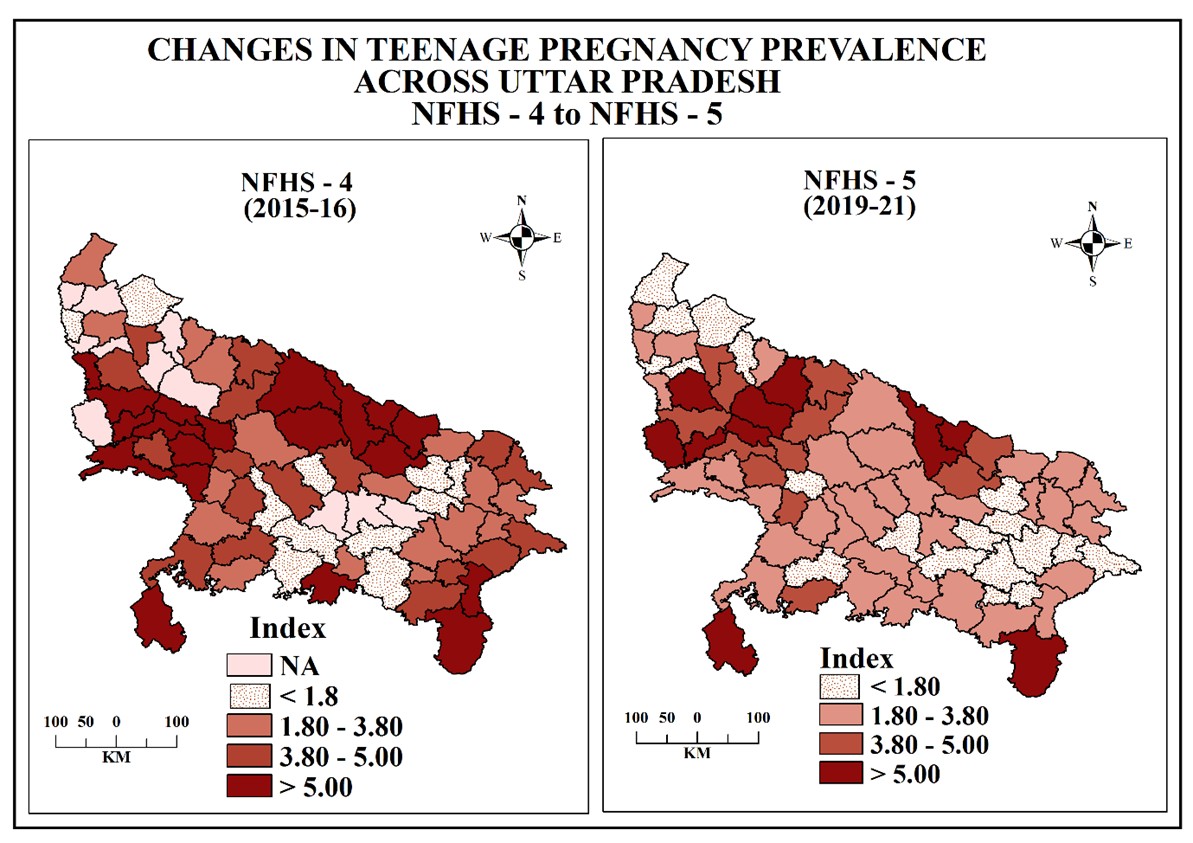
Teenage pregnancy remains a major public health concern in India, reflecting deep-rooted socio-economic and gender disparities. This study analyses the spatial and temporal trends of teenage pregnancy with a focus on Uttar Pradesh (UP), comparing NFHS-4 (2015–16) and NFHS-5 (2019–21) data. Findings reveal a marginal national decline but persistent high prevalence in UP, with distinct inter-district variations. A district-level socio-economic composite score was constructed for 71 districts (Census of India, 2011) using seven normalized indicators i.e., child marriage, ruralness, agricultural dependence, female literacy, anaemia prevalence, contraceptive use, and SC/ST population through min–max scaling and rational weightage in SPSS. Correlation analysis showed a strong negative association between socio-economic scores and teenage pregnancy prevalence, shows statistically significant under t-test validation. Districts were grouped into high, Medium-high, Medium-low, and low socio-economic categories using mean ± 0.5 SD thresholds, with variations visualized through boxplots and whisker charts. Kruskal–Wallis H-test confirmed significant regional disparities, while choropleth mapping identified persistent hotspots in eastern and southern UP. Overall, lower socio-economic status, poor literacy, and high child marriage prevalence correspond to higher teenage pregnancy rates, emphasizing the need for targeted regional interventions.
References
AJZEN, I. The theory of planned behavior. Organizational Behavior and Human Decision Processes, v. 50, n. 2, p. 179–211, 1991. https://doi.org/10.1016/0749-5978(91)90020-T
BANDURA, A. Social learning theory. Englewood Cliffs: Prentice Hall, 1977.
BHATIA, R. Teenage pregnancy and maternal health outcomes in low-income settings. Journal of Adolescent Health, v. 62, n. 2, p. 228–235, 2018.
BOSE, K. Determinants of early motherhood in North India. Asia-Pacific Population Journal, v. 30, n. 3, p. 57–72, 2015.
BRONFENBRENNER, U. The ecology of human development: Experiments by nature and design. Cambridge, MA: Harvard University Press, 1979. https://doi.org/10.4159/9780674028845
CHAUDHARY, R.; KUMARI, A. Adolescent pregnancy in Uttar Pradesh: trends and determinants. Journal of Population Studies, v. 34, n. 2, p. 45–60, 2018.
CHOUDHARY, R.; SETHI, V.; SHARMA, A. Adolescent reproductive health in India. Indian Journal of Public Health, v. 61, n. 3, p. 155–160, 2017. https://doi.org/10.4103/ijph.IJPH_217_17
ESRI. ArcGIS Desktop 10.2 [Computer software]. Redlands, CA: Environmental Systems Research Institute, 2013.
GANCHIMEG, T.; OTA, E.; MORISAKI, N.; LAOPAIBOON, M.; LUMBIGANON, P.; ZHANG, J.; YAMDAMSUREN, B.; TEMMERMAN, M.; SAY, L.; TUNÇALP, Ö.; VOGEL, J. P.; SOUZA, J. P.; MORI, R. Pregnancy and childbirth outcomes among adolescent mothers: A World Health Organization multicountry study. BJOG: An International Journal of Obstetrics & Gynaecology, v. 121, suppl. 1, p. 40–48, 2014.
GRECO, S.; ISHIZAKA, A.; TASIOU, M.; TORRISI, G. On the methodological framework of composite indices: A review of weighting, aggregation, and robustness. Social Indicators Research, 2019.
https://doi.org/10.1007/s11205-017-1832-9
GUPTA, A.; SHRIVASTAVA, A. Patterns of teenage fertility in Northern India. Indian Journal of Community Medicine, v. 44, n. 4, p. 320–327, 2019.
HINDIN, M. J.; FUNDER, K. Early marriage, fertility, and well-being. Studies in Family Planning, v. 47, n. 4, p. 235–248, 2016.
https://doi.org/10.1111/1471-0528.12630
INTERNATIONAL INSTITUTE FOR POPULATION SCIENCES (IIPS); ICF. National Family Health Survey (NFHS-4), 2015–16: India. Mumbai: IIPS, 2017.
INTERNATIONAL INSTITUTE FOR POPULATION SCIENCES (IIPS); ICF. National Family Health Survey (NFHS-5), 2019-21: India. Mumbai: IIPS, 2022.
INTERNATIONAL INSTITUTE FOR POPULATION SCIENCES (IIPS); MACRO INTERNATIONAL. National Family Health Survey (NFHS-3), 2005–06: India. Mumbai: IIPS, 2007.
JEJEEBHOY, S. Early marriage and reproductive health risks. Economic and Political Weekly, v. 40, n. 32, p. 3401–3412, 2005.
JEJEEBHOY, S.; SANTHYA, K. G. Adolescents and youth in India. New Delhi: Population Council, 2011.
KUMAR, C.; DAS, A. Risk factors of adolescent pregnancy in India: evidence from NFHS-4. BMC Public Health, v. 21, p. 1–10, 2021.
KUMARI, R.; SINGH, P.; KUMARI, N. Exploring the patterns and socio-economic determinants of teenage pregnancy in India. International Journal of Community Medicine and Public Health, v. 12, n. 5, p. 2124–2134, 2025. https://doi.org/10.18203/2394-6040.ijcmph20251365
KUNDU, S.; ALI, B.; DHILLON, P. Surging trends of infertility and its behavioural determinants in India. PLOS ONE, v. 18, n. 7, 2023
MICROSOFT CORPORATION. Microsoft Excel 2003 [Computer software]. Redmond, WA: Microsoft, 2003.
NAIR, P.; et al. Sociocultural dimensions of teenage pregnancy. Indian Journal of Social Work, v. 73, n. 4, p. 511–529, 2012.
OFFICE OF THE REGISTRAR GENERAL AND CENSUS COMMISSIONER, INDIA. Census of India 2011. New Delhi: Government of India, 2011.
POPULATION COUNCIL. UDAYA Wave 2: Uttar Pradesh Adolescent Survey. New Delhi: Population Council, 2020.
PATEL, T.; PRAKASH, A. A.; DASGUPTA, A.; SAHA, I. Impact of socio-economic inequalities on teenage pregnancy in India. International Journal of Reproductive Medicine, v. 2019, p. 1–8, 2019.
PRIYA, N.; SINGH, R. Education and adolescent fertility in Uttar Pradesh. Indian Journal of Population and Development, v. 45, n. 2, p. 89–104, 2020.
PRIYADHARSHANI, A.; SAHOO, B. K.; MISHRA, A.; SINGH, A. K.; PARIDA, S. P.; PANDA, A. Determinants of teenage pregnancy and knowledge about contraception, sexually transmitted diseases among pregnant women: A case-control study in Eastern India. Journal of Family Medicine and Primary Care, v. 13, n. 10, p. 4276–4283, 2024. https://doi.org/10.4103/jfmpc.jfmpc_183_24
RANI, M.; BONU, S. Socioeconomic factors and adolescent childbearing in India. Social Science & Medicine, v. 68, n. 4, p. 790–798, 2009.
RAY, S. C. Composite indices of development and poverty: An analysis of weighting methods. 2008
RODE, S. S. Teenage pregnancy in rural India. Demography India, v. 40, n. 1, p. 1–12, 2011.
SAGAR, S.; SINGH, A.; NANDA, P. Gender norms and adolescent reproductive behaviour in North India. Social Change, v. 50, n. 1, p. 79–96, 2020.
SAHOO, S.; SINHA, R. K.; MISHRA, S.; KUMAR, A. Early marriage and teenage pregnancy in Uttar Pradesh. Indian Journal of Public Health Research & Development, v. 14, n. 1, p. 123–132, 2023.
SAIKIA, N.; SINGH, A. Early marriage, adolescent fertility, and women’s empowerment in India. World Development, v. 85, p. 123–134, 2016. https://doi.org/10.1016/j.worlddev.2016.04.007
SENGUPTA, R.; BANERJEE, S. Spatial patterns of adolescent fertility in India. Population, Space and Place, v. 28, n. 1, p. 1–14, 2022.
SILVERMAN, J.; RAJ, A. Adolescent reproductive health in India. Reproductive Health Matters, v. 15, n. 29, p. 123–130, 2007.
https://doi.org/10.1016/S0968-8080(07)29300-0
SINGH, M.; SHEKHAR, C.; GUPTA, J. Distribution and determinants of early marriage and motherhood: A multilevel and geospatial analysis of 707 districts in India. BMC Public Health, v. 24, p. 2844, 2024. https://doi.org/10.1186/s12889-024-20038-2
SRIVASTAVA, A. Determinants of teenage motherhood in Uttar Pradesh: a district-level analysis. Demography India, v. 50, n. 2, p. 72–85, 2021.
UNFPA – UNITED NATIONS POPULATION FUND. Motherhood in Childhood: Facing the Challenge of Adolescent Pregnancy. New York: UNFPA, 2013.
UNICEF. Adolescent pregnancy in developing countries. 2021.
WORLD HEALTH ORGANIZATION. Adolescent pregnancy. Geneva: World Health Organization, 2020.

This work is licensed under a Creative Commons Attribution 4.0 International License.
Copyright (c) 2025 Nitin Kumar Mishra, Alok Nishad