
Palavras-chave
Domestic Violence
Autonomy
Mobility
Decision Making
Como Citar




Resumo
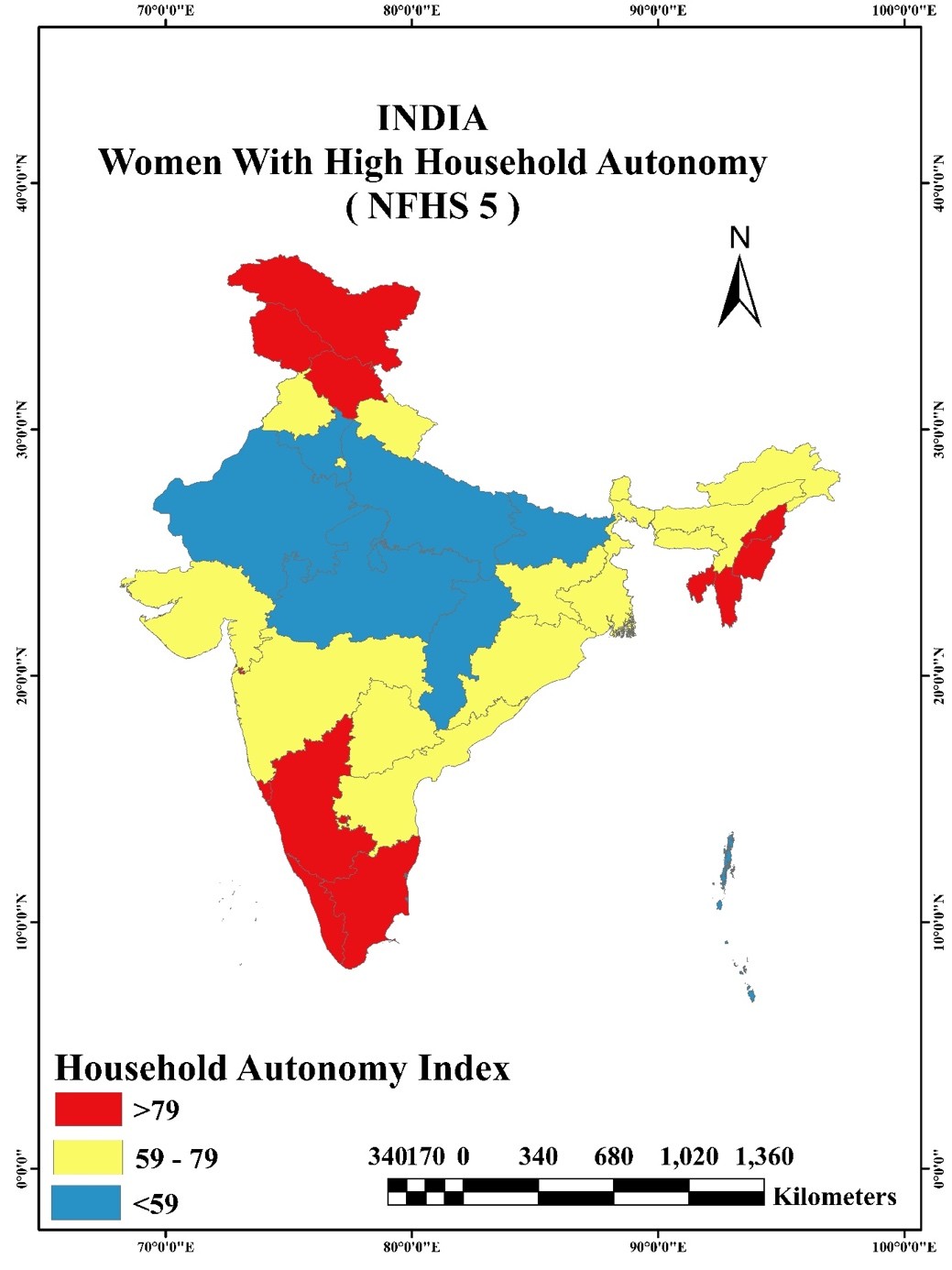
Women’s empowerment plays a vital role in advancing socio-economic development and promoting gender equality. In the Indian context, empowerment is shaped by factors such as educational attainment, economic participation, access to healthcare, and decision-making capacity. However, these determinants are unevenly distributed across regions, resulting in notable socio-spatial disparities. This study draws on data from the National Family Health Survey (NFHS-5, 2019–2021) to assess regional variations in women’s empowerment across three core dimensions: freedom of mobility, autonomy in household decision-making, and attitudes toward domestic violence. To quantify these dimensions, three composite measures—the Mobility Index, Household Autonomy Index, and Domestic Violence Attitude Index—were developed and applied across states. The analysis reveals distinct regional patterns. Southern states and several northeastern states exhibit relatively high levels of household autonomy, reflecting stronger educational and socio-economic conditions. However, mobility patterns within these regions show variability: states such as Manipur and Meghalaya display high levels of women’s movement outside the home, whereas some tribal-dominated areas demonstrate restricted mobility due to traditional norms and geographical constraints. Conversely, several northern states show limited mobility despite moderate household decision-making autonomy, suggesting deeply rooted patriarchal structures that constrain women’s public presence. Attitudes toward domestic violence further highlight cultural differences, often diverging from patterns of autonomy or mobility. Acceptance of domestic violence remains comparatively higher in northern and central states, indicating persistent gender norms that hinder empowerment even when other indicators show improvement. Based on the composite indices, states were categorized into high, medium, and low empowerment levels. Kerala, Tamil Nadu, and Goa consistently ranked in the high category, reflecting comprehensive social development. Maharashtra and Gujarat demonstrated intermediate progress, while Uttar Pradesh, Bihar, and Rajasthan remained in the low category. These spatial disparities reinforce the long-standing divide between the southern/northeastern states and the EAG/northern states, underscoring the need for region-specific policies that address structural inequalities, cultural barriers, and institutional gaps.
Referências
AGARWAL, B. Capacity building and empowerment of women in climate adaptation: a key to resilient communities. Environmental Research and Sustainability, v. 12, p. 214-230, 2018. https://doi.org/10.1016/j.ers.2018.02.014
ALLENDORF, K. Do women’s land rights promote empowerment and child health in Nepal? World Development, v. 35, n. 11, p. 1975–1988, 2007. https://doi.org/10.1016/j.worlddev.2006.12.005
ANDERSON, S. The Complexity of Female Empowerment in India. Studies in Microeconomics, v. 12, n. 1, p. 74–92, 2024. https://doi.org/10.1177/23210222241237030
BANERJEE, A.; DUFLO, E.; QIAN, N. On the road: Access to transportation infrastructure and economic growth in China. Journal of Development Economics, v. 145, p. 102442, 2020. https://doi.org/10.1016/j.jdeveco.2020.102442.
BANSAL, A.; KULLU, A.; DIXIT, P. Understanding the healthcare provider role on post-abortion contraception adoption in India using National Family Health Survey-5. Reproductive Health, v. 20, p. 123, 2023. https://doi.org/10.1186/s12978-023-01667-z
BARDHAN, K. Women's work, welfare and status: forces of tradition and change in India. Economic and Political Weekly, v. 20, n. 51, p. 2261–2267, 1985.
BATLIWALA, S. Taking the power out of empowerment – An experiential account. Development in Practice, v. 17, n. 4–5, p. 557–565, 2007. https://doi.org/10.1080/09614520701469559
BISWAS, S.; DAS, U.; SARKHEL, P. Duration of exposure to inheritance law in India: Examining the heterogeneous effects on empowerment. arXiv, 2020. https://doi.org/10.48550/arXiv.2010.11460
BLOOM, S. S.; WYPIJ, D.; GUPTA, M. D. Dimensions of women's autonomy and the influence on maternal health care utilization in a north Indian city. Demography, v. 38, n. 1, p. 67–78, 2001. https://doi.org/10.1353/dem.2001.0001
CHAKMA, M.; PANDEY, N. Women identity crisis in Northeast India: With special reference to village council of Mizoram, Nagaland and Meghalaya. International Journal of Health Sciences, v. 6, S5, p. 6094–6104, 2022. https://doi.org/10.53730/ijhs.v6nS5.10192
CHAKRABARTI, A. Understanding female autonomy in India through their family headship status. Journal of Population and Social Studies, v. 27, n. 3, p. 266–285, 2019. https://doi.org/10.25133/JPSSv27n3.0017
CHAKRABARTI, S.; BISWAS, C. S. An exploratory analysis of women’s empowerment in India: a structural equation modelling approach. The Journal of Development Studies, v. 48, n. 1, p. 164–180, 2012. https://doi.org/10.1080/00220388.2011.615920
CHARYA, D. R.; BELL, J. S.; SIMKHADA, P.; VAN TEIJLINGEN, E. R.; REGMI, P. R. Women's autonomy in household decision-making: a demographic study in Nepal. Reproductive Health, v. 7, p. 15, 2010. https://doi.org/10.1186/1742-4755-7-15
DESAI, S.; ANDRIST, L. Gender scripts and age at marriage in India. Demography, v. 47, n. 3, p. 667–687, 2010. https://doi.org/10.1353/dem.0.0118
DESOUZA, S. Situational Analysis of Women in Goa. New Delhi: National Commission for Women, 2004. Available: http://irgu.unigoa.ac.in/drs/bitstream/handle/unigoa/1815/Situational_Anal_Women_Goa_119.pdf?sequence=1&isAllowed=y Accessed on: sep. 13, 2025.
DEVARAJ, K.; GAUSMAN, J.; MISHRA, R.; McDOUGAL, L.; SILBERMAN, P. S.; RAJ, A. Trends in prevalence of unmet need for family planning in India: patterns of change across 36 States and Union Territories, 1993–2021. Reproductive Health, v. 21, p. 48, 2024. https://doi.org/10.1186/s12978-024-01781-6
DHAMIJA, G.; ROYCHOWDHURY, P.; SHANKAR, B. Urbanisation and Women Empowerment: Evidence from India. GLO Discussion Paper, n. 1323, 2023. https://doi.org/10.2139/ssrn.4656859
DIXON, M. R. Population Policies and Women's Rights: Transforming Reproductive Choice. Westport: Praeger, 1993. https://share.google/ZNkQ8ddYKXvLfFCFu Accessed on: aug. 18, 2025.
DYSON, T.; MOORE, M. On kinship structure, female autonomy, and demographic behavior in India. Population and Development Review, v. 9, n. 1, p. 35–60, 1983. https://doi.org/10.2307/1972894
GATHA COGNITION. Empowerment of women in India: Insights from decision-making and autonomy indicators (NFHS-4). Gatha Cognition, 2023. Available: https://gathacognition.com/site/htmlview/170/journal_article/open_access_plus. Accessed on: sep. 14, 2025.
GOEL, M.; RAVISHANKAR, N. Impact of public policy and legislation on autonomy and empowerment of women in India. Gender Issues, v. 39, n. 3, p. 198–219, 2022. https://doi.org/10.1007/s12147-021-09282-7
GOPALAKRISHNAN, L.; EL AYADI, A.; DIAMOND-SMITH, N. The role of community-level men's and women's inequitable gender norms on women's empowerment in India: A multilevel analysis using India's National Family Health Survey-5. PloS One, v. 19, n. 12, e0312465, 2024. https://doi.org/10.1371/journal.pone.0312465
GOVERNMENT OF INDIA. Annual Survey of Industries 2019–20 (Vol. II). Ministry of Statistics and Programme Implementation, 2021. Available: https://share.google/KkG0x1r2OWiH4omXi Accessed on: jul. 16, 2025.
GOVINDASAMY, PAVALAVALLI; MALHOTRA, Anju. Women's Position and Family Planning in Egypt. Studies in Family Planning, v. 27, n. 6, p. 328-340, 1996. https://doi.org/10.2307/2138028
GUPTA, A.; ASHTT, R.; MONGA, A. Perceived Safety of Women in Public Spaces: Analyzing Challenges and Policy Interventions in the NCT of Delhi. International Journal of Environmental Sciences, v. 11, n. 15s, 2025. https://doi.org/10.64252/t4zpe440
GUPTA, K.; YESUDIAN, P. P. Evidence of women’s empowerment in India: A study of socio-spatial disparities. GeoJournal, v. 65, p. 365–380, 2006. https://doi.org/10.1007/s10708-006-7556-z
HOWARD-HASSMANN, R. E. Universal women’s rights since 1970: The centrality of autonomy and agency. Journal of Human Rights, v. 10, n. 4, p. 433–449, 2011. https://doi.org/10.1080/14754835.2011.619398
INDIA. Ministry of Women and Child Development; Development Monitoring and Evaluation Office (DMEO). Sector Report 2021 – Women and Child Development. New Delhi: DMEO, 2021. Available: https://dmeo.gov.in/reports-working/sector-report-2021-women-child-development. Accessed on: 2 dez. 2025.
IIPS - International Institute for Population Sciences. ICF. National Family Health Survey (NFHS-5), 2019-21: India report. Mumbai: IIPS, 2021. Available: http://rchiips.org/nfhs/NFHS-5Reports/NFHS-5_INDIA_REPORT.pdf. Accessed on: dec. 2, 2025.
JAISINGH, I. Violence against women: the Indian perspective. In: PETERS, J.; WOLPER, A. (eds.). Women's Rights, Human Rights. New York: Routledge, 2018. Available: https://share.google/D8S2aCEo27w2WjNDt. Accessed on: 2 dez. 2025.
JEJEEBHOY, S. Women's autonomy in rural India: Its dimensions, determinants, and the influence of context. In: PRESSER, H. B.; SER, G. (eds.). Women's empowerment and demographic processes: moving beyond Cairo. New York: Oxford University Press, 2000. https://doi.org/10.1093/oso/9780198297314.003.0009
JEJEEBHOY, S. J.; SATHAR, Z. A. Women’s autonomy in India and Pakistan: The influence of religion and region. Population and Development Review, v. 27, n. 4, p. 687–712, 2001. https://doi.org/10.1111/j.1728-4457.2001.00687.x
JEJEEBHOY, S. J.; COOK, R. J. State accountability for wife beating: the Indian challenge. The Lancet, v. 350, n. 9087, p. 1286 1290, 1997. https://doi.org/10.1016/S0140-6736(97)90004-0
JOSEPH, V.; MADHURI, N. V. Mapping Gender Gap in Achieving the Sustainable Development Goals in India. Journal of Rural Development, v. 42, n. 3, p. 183–187, 2024. https://doi.org/10.25175/jrd/2023/v42/i3/173262
KABEER, N. Gender equality, economic growth, and women’s agency: the “endless variety” and “monotonous similarity” of patriarchal constraints. Feminist Economics, v. 22, n. 1, p. 295–321, 2016. https://doi.org/10.1080/13545701.2015.1090009
KAPUR, R.; NARAYAN, S. Women empowerment in India: more needs to be done. ISAS Insights, 2020. Available: https://www.isas.nus.edu.sg/papers/women-empowerment-in-india-more-needs-to-be-done/. Accessed on: sep. 29, 2025
KABEER, N. Resources, agency, achievements: reflections on the measurement of women's empowerment. Development and Change, v. 30, n. 3, p. 435-464, 1999. https://doi.org/10.1111/1467-7660.00125.
KABEER, N. Money can't buy me love? Re-evaluating gender, credit and empowerment in rural Bangladesh. Brighton: Institute of Development Studies, 1998. Available: https://hdl.handle.net/20.500.12413/13879. Accessed on: dez. 2, 2025
KABEER, Naila. Social exclusion, poverty and discrimination: towards an analytical framework. IDS Bulletin, v. 31, n. 4, p. 83-97, 2000. https://doi.org/10.1111/j.1759-5436.2000.mp31004009.x.
KAUR, B.; RAO, N.; CHOUHAN, P. Working Women, Delhi Metro and Covid-19: A Case Study in Delhi-NCR. Journal of Transport & Health, v. 21, 2021. Available: https://pmc.ncbi.nlm.nih.gov/articles/PMC8161715/. Accessed on: oct. 25, 2025.
KHADER, S. Beyond Autonomy Fetishism: Affiliation with Autonomy in Women’s Empowerment. Journal of Human Development and Capabilities, v. 17, n. 1, p. 125–139, 2015. https://doi.org/10.1080/19452829.2015.1025043
KISHOR, S.; GUPTA, K. Women's Empowerment in India and Its States: Evidence from the NFHS. Economic and Political Weekly, v. 39, p. 694–712, 2004. https://doi.org/10.2307/4414645
KUMAR, N.; KAUR, N. Impacts of self-help group membership on women’s empowerment in India. World Development, v. 105592, 2021.https://doi.org/10.1080/14754835.2011.619398
KUMAR, S.; MONDAL, S. Empowerment of women from the experience of Indian states: a reflection of NFHS-5. GeoJournal, v. 89, n. 2, p. 64, 2024. https://doi.org/10.1007/s10708-024-11065-y
KUMARI, S.; SIOTRA, V. Indian females in the twenty-first century: How have they fared? An analysis using geospatial techniques. GeoJournal, 2023. https://doi.org/10.1007/s10708-023-10865-y
MALHOTRA, A.; SCHULER, S. R.; BOENDER, C. Measuring women's empowerment as a variable in international development. Unpublished paper prepared for the World Bank, 2002.
MALHOTRA, A.; MATHER, M. Do schooling and work empower women in developing countries? Gender and domestic decisions in Sri Lanka. Sociological Forum, v. 12, n. 4, p. 599–630, 1997. https://doi.org/10.1023/A:1022126824127
MANNA, S.; GUPTA, V.; SANCHAYA, S.; GARG, A. Inequities in maternal child health, education, and empowerment among tribal population in India. Journal of Family Medicine and Primary Care, v. 11, n. 11, p. 7150–7157, 2022. https://doi.org/10.4103/jfmpc.jfmpc_594_22
MANYA SAHNI, P. Performance & initiatives of India in achieving SDG5 i.e. gender equality. Educational Administration: Theory and Practice, v. 30, n. 11, p. 2201–2209, 2024. https://doi.org/10.53555/kuey.v30i11.10353
MASON, K. O.; SMITH, H. L. Husbands' versus wives' fertility goals and use of contraception: The influence of gender context in five Asian countries. Demography, v. 37, n. 3, p. 299-311, 2000. https://doi.org/10.2307/2648043
MCKNELLY, B.; MCCORD, M. Credit with education on women's empowerment impact review n. 1, October 2001. Available: https://share.google/a1ud8YtDbySeMtXDj. Accessed on: oct. 23, 2025.
MENON, N. Women in ‘Kerala Model’: Myths and Realities. In: Mobility as Capability. Cambridge: Cambridge University Press, 2020. https://doi.org/10.1017/9781108836425.004
MENON, S. V.; ALLEN, N. E. Domestic violence and community organizing in India. In: PERKINS, J.; ZIMMERMAN, M. (eds.). The Cambridge Handbook of Community Empowerment, p. 83–109. Cambridge: Cambridge University Press, 2024. https://doi.org/10.1017/9781009265013.008
MINISTRY OF HEALTH AND FAMILY WELFARE 2021. Available: https://mohfw.gov.in/. Accessed on: dec. 2, 2025
MONDAL, D.; KARMAKAR, S.; BANERJEE, A. Women's autonomy and utilization of maternal healthcare in India: Evidence from a recent national survey. PloS One, v. 15, n. 12, e0243553, 2020. https://doi.org/10.1371/journal.pone.0243553
NATIONAL RESEARCH COUNCIL. Educating children with autism. Washington, DC: National Academy Press, 2001. Division of Behavioral and Social Sciences and Education.
NAYAK, P.; MAHANTA, B. Women empowerment in India. Bulletin of Political Economy, v. 5, n. 2, 2008. https://doi.org/10.2139/ssrn.1320071
PANDEY, N.; KHAN, N.; SHUKLA, N.; PANDEY, R.; DWIVEDI, A. K. Determinants of women empowerment among tribal women in India: Evidence from NFHS-5 (2019–21). Journal of Family Medicine and Primary Care, v. 12, n. 2, p. 287–296, 2023. Available: https://pmc.ncbi.nlm.nih.gov/articles/PMC10041329/. Accessed on: sep. 23, 2025.
PANDEY, P.; CHOUBEY, A. K.; RAI, G. The Involvement of Women as the Domestic Decision Maker: A Study of Patna Metropolitan City, Bihar, India. Sociedade & Natureza, v. 33, 2021. https://doi.org/10.14393/SN-v33-2021-62053
RAGHUVANSHI, Sharmishtha; NIKAM, Supriya Sanjay; KARNE, Manisha; KOTHE, Satyanarayan Kishan. Unmasking inequity: socio-economic determinants and gender disparities in Maharashtra and India's health outcomes — Insights from NFHS-5. arXiv:2506.08206, 2025. https://doi.org/10.48550/arXiv.2506.08206
RAGHUWANSHI, J.; DHENGLE, A. Funds and fears: how crime against women undermines gender equality in India. Asian Women, v. 41, n. 1, p. 141-165, Mar. 2025. https://doi.org/10.14431/aw.2025.3.41.1.141
RANGANATHAN, M.; KNIGHT, L.; ABRAMSKY, T.; MUVHANGO, L.; NGWATO, T. P.; MBOBELATSI, M.; FERRARI, G.; WATTS, C.; STÖCKL, H. Associations between women’s economic and social empowerment and intimate partner violence: Findings from a microfinance plus program in rural North West Province, South Africa. Journal of Interpersonal Violence, v. 36, n. 15–16, NP8624–NP8650, 2021. https://doi.org/10.1177/0886260519836952
SAHNI, S.; KAUSHAL, L. A.; GUPTA, P. Gendered differences and strategies for work-life balance: systematic review based on social ecological framework perspective. Acta Psychologica, v. 242, 2025. https://doi.org/10.1016/j.actpsy.2025.105019
SHARMA, M. Constitution and Gender Justice. International Journal of Law, Management & Humanities, v. 8, n. 2, p. 2602–2606, 2025. https://doij.org/10.10000/IJLMH.119334
SHARMA, P. Digital revolution of Education 4.0. International Journal of Engineering and Advanced Technology, v. 9, p. 3558-3564, 2019. https://doi.org/10.35940/ijeat.A1293.129219
SHREEMOYEE, Shreemoyee; ROYCHOWDHURY, Punarjit; DHAMIJA, Gaurav. Women’s attitudes towards physical intimate partner violence in India: trends, patterns, and determinants. Plos One, v. 20, p. e0318350, 2025. https://doi.org/10.1371/journal.pone.0318350
SHRUTHEE, S. G.; SENTHIL ARASI; SEENIVASAN, P. Voluntary and rights-based family planning for women: Observations from a community-based study in southern India. Indian Journal of Medical Ethics, 2025. https://doi.org/10.20529/IJME.2025.010
SINGH, A.; CHOKHANDRE, P.; SINGH, A. K.; BARKER, K. M.; KUMAR, K.; McDOUGAL, L.; JAMES, K. S.; RAJ, A. Development of the India Patriarchy Index: Validation and Testing of Temporal and Spatial Patterning. Social Indicators Research, v. 159, p. 351–377, 2022. https://doi.org/10.1007/s11205-021-02752-1
SINGH, B.; SINGH, S. K. Evolving dimensions of women's empowerment in India. PloS One, v. 20, n. 7, e0327494, 2025. https://doi.org/10.1371/journal.pone.0327494
SINGH, D. A literature review on employee retention with focus on recent trends. International Journal of Scientific Research in Science, Engineering and Technology, v. 6, p. 425–431, 2019. https://doi.org/10.32628/IJSRST195463
SINGH, M. Sanjoy. Empowerment of women in Manipur – a study based on IMA market introduction. International Seminar on New Education Policy (NEP) and NAMODI Framework, IGNTU, Amarkantak, July 2016. Available: https://share.google/OAnzTXydJzoRncNPY. Accessed on: aug. 13, 2025.
SINGH, R.; SINGH, R. K. Women empowerment index for India: A state-wise analysis using NFHS-5 data. Journal of Health, Population, and Nutrition, v. 43, n. 1, p. 1–14, 2024. Available: https://pmc.ncbi.nlm.nih.gov/articles/PMC11346798/. Accessed on: nov. 25, 2025.
SINGH, R.; RAI, R. K.; SINGH, P. K. Assessing the utilization of maternal and child health care among married adolescent women: Evidence from India. Journal of Biosocial Science, v. 52, n. 1, p. 97–110, 2020a.
SINGH, R.; SINGH, P. K.; PARASURAMAN, S. Women’s autonomy and utilization of maternal healthcare in India. Clinical Epidemiology and Global Health, v. 8, n. 3, p. 666–670, 2020b. https://doi.org/10.1016/j.cegh.2019.12.009
SINGH, S. K.; SHARMA, B.; VISHWAKARMA, D. Inequalities in Women’s Empowerment and Their Vulnerability to HIV in India. Journal of AIDS Clinical Research and STDs, 2016. http://dx.doi.org/10.24966/ACRS-7370/100007
SINGH, S.; KUMAR, S. Gender dynamics in household financial decision-making: A socio-economic analysis of urban and rural households in Hamirpur, Himachal Pradesh. International Journal of Law, Management & Humanities, v. 8, n. 2, p. 655–672, 2025. https://doi.org/10.10000/IJLMH.119162
TAYAL, C.; SHARMA, R.; LATA, K. Association between women's autonomy and reproductive health outcomes in India. Journal of Medicine, Surgery and Public Health, v. 4, Suppl C, 2024. https://doi.org/10.1016/j.glmedi.2024.100156
TSEO - TELANGANA SOCIO-ECONOMIC OUTLOOK. Telangana Socio-Economic Outlook 2025 (Budget Day publication). Government of Telangana, 2025.
UN WOMEN. Effective approaches to preventing violence against women in Asia and the Pacific. UN Women Asia and the Pacific, 2022. Available: https://asiapacific.unwomen.org. Accessed on: oct. 17, 2025.
UNITED NATIONS. Transforming our world: the 2030 Agenda for Sustainable Development. New York: United Nations, 2015. Disponível em: https://sdgs.un.org/2030agenda
VIGNITHA, B.; DEBNATH, A.; PVS, A.; SAI, T. K.; CHARAG, S. Women's Empowerment in India: State-Wise Insights From the National Family Health Survey 5. Cureus, v. 16, n. 7, e65509, 2024. https://doi.org/10.7759/cureus.65509
XAXA, V. Women and gender in the study of tribes in India. Studies in Tribes and Tribals, v. 11, n. 3, 2004. https://doi.org/10.1177/097152150401100304

Este trabalho está licenciado sob uma licença Creative Commons Attribution 4.0 International License.
Copyright (c) 2025 Shrinkhla Pandey, Shubham Kumar, Gayatri Rai