
Keywords
Recreation Area
Soil Bioavailability
Trace Metals
How to Cite




Abstract
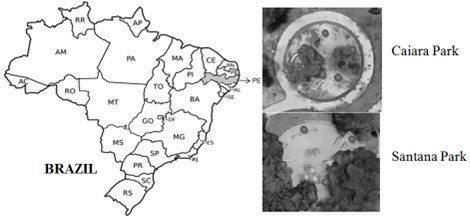
Children and the elderly are the most vulnerable to health problems, due to possible direct contact with contaminated soil and the inhalation of exhaust fumes. Also, quantifying chemical species of metals in soil is essential for estimating the bioavailability of the metals in the environment. The “Capibaribe Melhor” Project launched by the City Hall of Recife – PE – Brazil includes two large parks, Santana and Caiara. The Project involves environmental education actions, construction of a pier, and squares, with the aim of revamping the Capibaribe River, the city's main body of water, drawing the attention of the local population to the need to preserve the Capibaribe River and, at the same time, offering areas for entertainment and recreation. Parks usually attract the neighboring inhabitants, but their soils contain varying amounts of toxic trace metals such as As, Cd, Cu, Cr, Fe, Hg, Pb, Ni, Sn, Zn, Mn, Si, Pb and Sc, mainly because of atmospheric pollution from vehicles' exhausting pipes. This study aims to determine the metal distribution in geochemical phases of soil in parks and presents the total concentrations of chemical elements in soils collected in parks, obtained by Energy Dispersion X-Ray Fluorescence (EDXRF). The more toxics metals found in this study were: Al, Zn, Cu, and Pb, while the major chemical elements analyzed were Fe, K, Ca, and Si. Sequential extraction showed the presence of major metals (Mn and Fe) and minor ones (Zn and Cu), mainly in the oxidizable phase followed by the leachable or pseudo-residual phase. Only Mn is also highlighted in the leachable fraction. The results emphasize the importance of determining the chemical form of heavy metals in soil in parks to assess the availability and long-term environmental consequences of soil contamination and the effects of these new chemical pollutants that cause so-called noncommunicable diseases (NCDs).
References
ADRIANO D. C. Trace Elements in the Terrestrial Environment. Ed. Springer-Vrlag, New York, p.147, 1986. https://doi.org/10.1007/978-1-4757-1907-9
AGUIAR, J. E; MARINS, R. V.; ALMEIDA, M. D.; Comparação de metodologias de digestão de sedimentos marinhos para caracterização da geoquímica de metais-traço na plataforma continental nordeste oriental brasileira. Geochimica Brasiliensis, v. 21, n. 3, p. 304 -323. 2007.
ALAMGIR, M.; ISLAM, M.; HOSSAIN, N.; KIBRIA, M. G.; RAHMAN, M. M. Assessment of heavy metal contamination in urban soils of Chittagong City, Bangladesh. International Journal of Plant Production., v. 7, n. 6, p. 362–372, 2015. https://doi.org/10.9734/IJPSS/2015/18424
CPRH-Agência estadual de meio ambiente. Instrução normativa CPRH n° 007/2014. Diário oficial do Estado de Pernambuco – Poder Executivo, 2014.
FABIAŃSKA, M. J.; KOZIELSKA, B.; KONIECZYŃSKI, J.; BIELACZYC, P. Occurrence of organic phosphates in particulate matter of the vehicle exhausts and outdoor environment – A case study. Environmental Pollution, v. 244, p. 351-360, 2019. https://doi.org/10.1016/j.envpol.2018.10.060
FERNÁNDEZ, Z. H.; SANTOS- JÚNIOR, J. A.; AMARAL, R. S.; ALVAREZ, E. J. R.; SILVA, E. B.; FRANÇA. E. J.; MENEZES, R. S. C.; FARIAS, E. E. G.; SANTOS, J. M. N. EDXRF as an alternative method for multielement analysis of tropical soils and sediments. Environmental Monitoring and Assessment, v. 189, p. 447, 2017. https://doi.org/10.1007/s10661-017-6162-5
GOOGLE MAPS. Available: https://www.google.com/maps/. Accessed on: jul. 26, 2022.
GUILHERME, L. R. G.; MARQUES, J. J.; PIERANGELI, M. A. P.; ZULIANI, D. O. S.; CAMPOS, M. L.; MARCHI, G. Elementos-traço em solos e sistemas aquáticos. In: VIDAL-TORRADOP, ALLEONI, L. R. F.; COOPER, M.; SILVA, A. P.; CARDOSO. E. J. Tópicos de ciência do solo, v. 4, p. 345-390, 2005. http://dx.doi.org/10.13140/2.1.4821.1524
GUOA, X.; MAA, Y.; WANGB, X.; CHEN, S. Re-evaluating the effects of organic ligands on copper toxicity to barley root elongation in culture solution. Chemical Speciation and Bioavailability, v. 22, n. 1, p. 51 – 59. 2010. https://doi.org/10.3184/095422910X12632121425090
INTERNATIONAL ORGANIZATION FOR STANDARDIZATION - ISO 13528:2005. Statistical methods for use in proficiency testing by interlaboratory comparisons, 2005.
KABATA-PENDIAS, A.; PENDIAS, H. Trace elements in soils and plants. Ed Boca Raton: CRC Press. 2001. https://doi.org/10.1201/9781420039900
LANGE, C. N. Evaluation of contamination of soils and groundwater by potentially toxic elements and traits in a vehicle collection yard. Case study: Ribeirão Preto, SP. PhD thesis in Sciences in the Area of Applications in Nuclear Technology, IPEN, São Paulo, 2018.
https://doi.org/10.11606/T.85.2018.tde-25042018-104820
LIANG, Y.; ZHANG, J.; XIAO, X.; XING, M.; LU, Y.; WANG, L. RISK Assessment of Heavy Metals in Overlapped Areas of Farmland and Coal Resources in Xuzhou, China. Bulletin of Environmental Contamination and Toxicology, 2021. https://doi.org/10.1007/s00128-021-03337-x
LIMA, V. L.; SOUZA, V. L. B.; NASCIMENTO, R. K.; SANTOS, P. N. C.; ALMEIDA, M. G. O.; HAZIN, C. A. Metal fractionation in sediments as a tool for assessing the availability of trace metals: The case of Apipucos Reservoir. Radiation Physics and Chemistry. v. 95, p. 329-332. 2014. https://doi.org/10.1016/j.radphyschem.2013.01.015
SHARAMEL, O.; MICHALKE, B.; KETTRUP, A. Study of the copper distribution in contaminated soils of hop fields by single and sequential extraction procedures. Science of the Total Environment. v. 263, p. 11 – 22. 2000. https://doi.org/10.1016/S0048-9697(00)00606-9
SOUZA, V. L. B.; BARBOSA, S. D.; SILVA, W.; SOARES, A. L. B.; VILLAR, H. P. A.Characterization of soils from recreational parks in Pernambuco – Brazil. Agricultural Science Research Journal, v. 10, p. 55 - 61, 2020.
SOUZA, V. L. B.; BARBOSA, S. D.; SILVA, L. C. D.; SILVA, W. A. Soil Metals and Sediments: A Review, Journal of Engineering Research, v. 2, n. 12, p. 1 – 6. 2022. https://doi.org/10.22533/at.ed.3172122230061
TESSIER, A.; CAMPBELL, P.; BISSON, M. Sequential extraction procedure for the speciation of particulate trace metals. Analytical Chemistry, v. 51, p. 844 – 851, 1979. https://doi.org/10.1021/ac50043a017
THOMAS, R. L. A protocol for the selection of process-oriented remedial options to control in situ sediment contaminants. Hydrobioloia, 149: 247 – 258, 1987. https://doi.org/10.1007/BF00048664
TING L.; SHU-HUA Z.; XIU-PING X.; KUN Y.; JING-YA W.; YAN Z.; FEI L. Environmental Background Values of Heavy Metals and Physicochemical Properties in Different Soils in Shenzhen. Huan Jing Ke Xue, v. 42, n. 7, pp. 3518-3526, 2021. Available: https://link.cnki.net/doi/10.13227/j.hjkx.202011082. Accessed on: Jul. 08, 2021.
WATTS, M. J.; MITRA, S.; MARRIOTT, A. L.; SARKAR, S. K. Source, distribution and ecotoxicological assessment of multielement in superficial sediments of a tropical turbid estuarine environment: A multivariate approach. Marine Pollution Bulletin, v. 115, p. 130–140. 2017. https://doi.org/10.1016/j.marpolbul.2016.11.057
WU, Y.; PENG, X.; HU, X. Vertical distribution of heavy metal in soil of abandoned vehicles dismantling area. Asian Journal of Chemistry, v. 25, p. 8423-8426, 2013. https://doi.org/10.14233/ajchem.2013.14770
XIANGDONG-LI; ZHENGUO-SHEN; ONYX, W.; YOK-SHEUNG, L. Chemical Partitioning of heavy metal contaminants in sediments of the Pearl River Estuary. Chemical Speciation and Bioavailability, v. 12, n. 1, p. 17 – 25. 2015. https://doi.org/10.1016/j.marpolbul.2016.11.057

This work is licensed under a Creative Commons Attribution 4.0 International License.
Copyright (c) 2025 Vivianne Lúcia Bormann de Souza, Sandra Dias Barbosa, Suzana Oliveira Santos, Waldecy Ananias da Silva, Lorena Colliard de Farias Antas, Crescêncio Andrade Silva Filho