
Keywords
Geoparks;
Symbolic appropriation;
Interpretive media;
How to Cite




Abstract
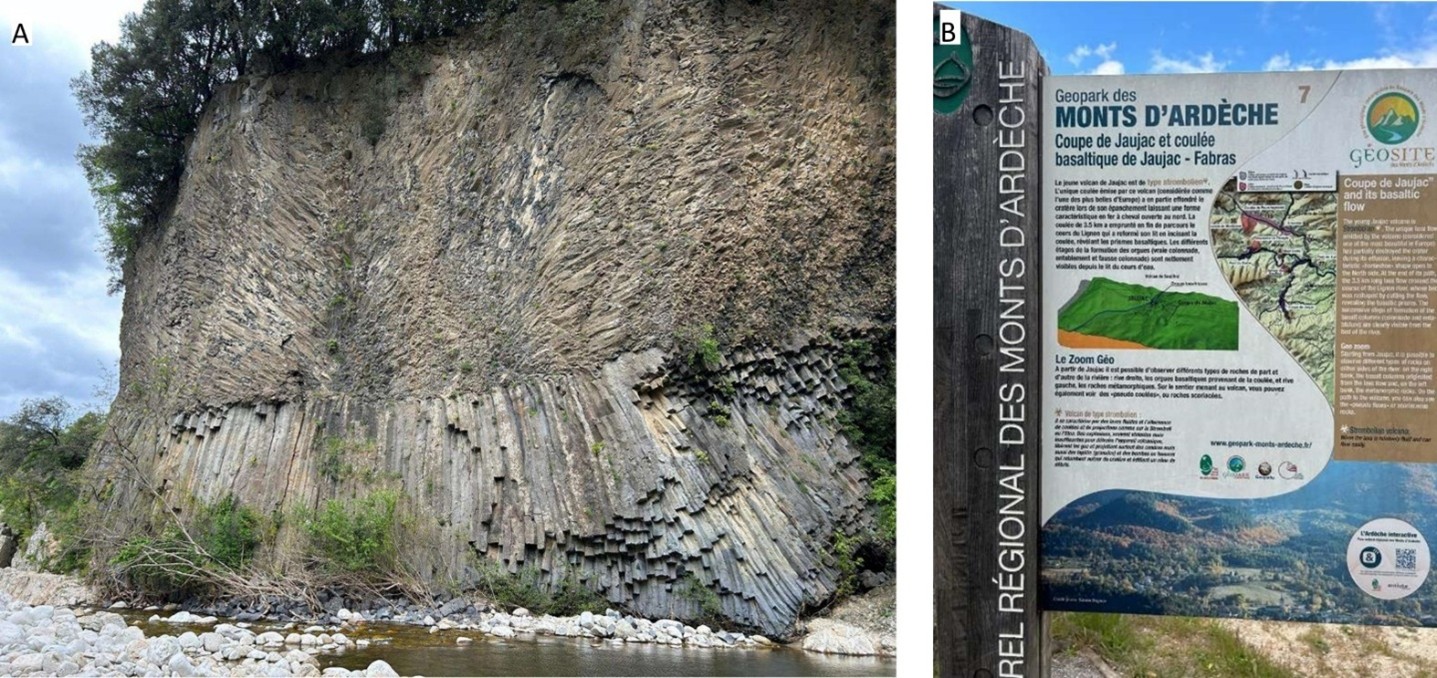
This article investigates interpretive panels at geosites in three French geoparks, aiming to understand how different narrative strategies communicate aspects of geoheritage. The research adopts a qualitative approach, based on a critical analysis of 17 panels collected in the field. The theoretical framework is grounded in the heritage typology proposed by Doumit (2007), which identifies five narrative dimensions — scientific, historical, symbolic, artistic, and sensory — along with an analytical framework encompassing four interpretive approaches: educational, communicational, discursive, and integrative. The results indicate a predominance of the scientific/natural dimension in the analyzed panels, highlighting an emphasis on technical and geological aspects. However, in some cases, there is articulation with other dimensions, such as historical, symbolic, and sensory, especially when the content relates to social practices, local memories, or cultural elements. These connections enrich the interpretive experience and provide a more contextualized reading of the territory. Regarding interpretive approaches, educational and communicational orientations prevail, focusing on technical explanations and visual resources, which help make scientific content accessible to diverse audiences but tend to limit active visitor participation. In contrast, discursive and integrative approaches — which encourage visitors to co-construct meaning and foster emotional connections to places — are less frequent, indicating an underexplored potential. The discussion proposes a reflection on the role of interpretive devices as cultural mediators of territory, emphasizing their capacity to construct meaning, promote belonging, and strengthen the relationship between communities, landscapes, and local heritage. By combining knowledge, memory, and experience, such devices can contribute to broader processes of social valorization and appropriation of geoheritage. The study also engages with Brazilian experiences and reinforces the importance of interpretive strategies that integrate multiple heritage dimensions through more sensitive and participatory approaches. It advocates for cultural mediation that promotes community involvement, a sense of belonging, and actions oriented toward sustainability, thereby enhancing the social and educational impacts of geoparks.
References
BALME, C.; LEGAL, S. Plan de gestion 2019 – 2028. Section A. Diagnostic. Apt: Parc naturel régional du Luberon, 2018.
BECK, L.; CABLE, T. Interpretation for the 21st Century: fifteen guiding principles for interpreting nature and culture. Champaign IL: Sagamore Publishing, 1998.
BÉTARD, F.; ROUGET, I.; HOBLÉA, F.; AUBRON, I.; BILLET, P.; EGOROFF, G.; GIUSTI, C.; POIRAUD, A.; PORTAL, C. Geoconservation in France: history, key policies, and current tools. Geoheritage, [s. l.], v. 15, n. 52, 2023. https://doi.org/10.1007/s12371-023-00824-x.
BORBA, A. W. de; MILETTO, M. F.; CORRÊA, A. P. S.; MOTTA, V. L.; FISCHER, M. P.; BRUNHAUSER, T. D.; LOPES, R. P.; GUADAGNIN, F. Avaliação da linguagem e aspectos visuais de painéis interpretativos turísticos para geomonumentos e outros elementos geopatrimoniais do corede campanha, RS, Brasil. Geografia: Ensino & Pesquisa, [s. l.], v. 24, e. 22, 2020. https://doi.org/ 10.5902/2236499437740.
BRILHA, J. Inventory and quantitative assessment of geosite and geodiversity sites: a review. Geoheritage, [s. l.], v. 8, n. 2, 2016. https://doi.org/10.1007/s12371-014-0139-3.
CAYLA, N. Le patrimoine géologique de l’arc alpin: de la médiation scientifique à la valorisation géotouristique. 2009. 307f. Thèse (Doctorat en Géographie) – Université de Savoie, Laboratoire EDYTEM, 2009.
COSTA, A. P. L.; FRANÇA, L. H. F.; NASCIMENTO, M. B.; OLIVEIRA, N. S. M.; HENRIQUES, M. H. P. Trilhas educativas: caminhos que levam a novos conhecimentos no Geoparque Seridó/RN. Geoconexões, [s. l.], v. 2, n. 14, 2022. https://doi.org/10.15628/geoconexes.2022.14680.
DOUMIT, L. M. La valorisation du patrimoine endokarstique libanais. 2007. 280 f. Thèse (Doctorat en Géographie – Aménagement Touristique et Culturel) – Université Saint-Joseph, Beyrouth; Université de Savoie, Chambéry, 2007.
DU, Y.; GIRAULT, Y. A genealogy of UNESCO Global Geopark: emergence and evolution. International Journal of Geoheritage and Parks, [s. l.], v. 6, 2018. https://doi.org/10.17149/ijgp.j.issn.2577.4441.2018.02.001.
DUVAL, M.; GAUCHON, C. The Janus-faced dilemma of rock art heritage management in Europe: a double dialectic process between conservation and public outreach, transmission and exclusion. Conservation and Management of Archaeological Sites, [s. l.], v. 21, n. 5-6, p. 310–343, 2021. https://doi.org/10.1080/13505033.2020.1860329.
FRANÇOIS, H.; HIRCZAK, M.; SENIL, N. Territoire et patrimoine: la co-construction d’une dynamique et de ses ressources. Revue d’Économie Régionale & Urbaine, Paris, n. 5, p. 683–700, 2006. https://doi.org/ 10.3917/reru.065.0683.
GRAY, M. Geodiversity: valuing and conserving abiotic nature. 2. ed Chichester: Wiley-Blackwell, 2013.
GRAY, M. Broadening the definition of Geodiversity by including atmosphere and oceans. In: OXFORD GEOHERITAGE VIRTUAL CONFERENCE, 2025, Online. Anais [...]. Disponível em: https://www.oxgvc.co.uk/uploads/2/1/4/8/21486764/oxgvc2025_abstract_volume_v2.pdf. Acesso em: 27 jun. 2025.
HENRIQUES, M. H.; REIS, R. P. dos. Storytelling the geoheritage of Viana do Castelo (NW Portugal). Geoheritage, [s. l.], v. 13, n. 46, 2021. https://doi.org/10.1007/s12371-021-00569-5.
HOWARD, P. Heritage: management, interpretation, identity. London: Continuum, 2003. https://doi.org/10.5040/9781350933941.
KNACKMUHS, E. The influence of policy narratives on policy preferences and interpretive outcomes at heritage sites. 2017. Tese (Doutorado em Saúde Pública) – Indiana University, School of Public Health, Bloomington, 2017.
LEE, S. Empowering the invisible: heritage interpretation as a tool for inclusion. In: INTERPRET EUROPE. SUSTAINABILITY: CHALLENGING MINDSETS THROUGH HERITAGE INTERPRETATION, 1, 2024, Potsdam. Proceedings [...]. Potsdam: Interpret Europe, 2024. p. 20–27.
MANSUR, K. L.; NASCIMENTO, V. M. L. do. Popularización del conocimiento geológico: metodología del proyecto “Caminhos Geológicos”. Enseñanza de las Ciencias de la Tierra, [s. l.], v. 15, n. 1, p. 77–84, 2007.
MCKEW, R. AIM Success Guide: Museum Displays and Interpretation. Cambridge: Association of Independent Museums, 2022. Disponível em: https://aim-museums.co.uk. Acesso em: 19 maio 2025.
MOREIRA, J. C. Geoturismo e interpretação ambiental. Ponta Grossa: Editora UEPG, 2014. https://doi.org/10.7476/9788577982134.
MOSCARDO, G. Interpretation and tourism: Holy grail or emperor’s robes? International Journal of Culture, Tourism and Hospitality Research, [s. l.], v. 8, n. 4, p. 462–476, 2014. https://doi.org/10.1108/IJCTHR-08-2014-0071.
NOWACKI, M. Heritage interpretation and sustainable development: a systematic literature review. Sustainability, Switzerland, v. 13, n. 8, 2021. https://doi.org/10.3390/su13084383.
OLIVEIRA, P. C. A. de; BENTO, L. C. M.; RODRIGUES, S. C. Os painéis interpretativos como recurso para a valorização e a divulgação dos geossítios do Parque Estadual do Pau Furado, Minas Gerais. Sociedade & Natureza, Uberlândia, v. 29, n. 3, p. 397–408, 2017. http://dx.doi.org/10.14393/SN-v29n3-2017-3.
PORTAL, C.; AUBRON, I. Géoparcs et parcs naturels régionaux: étude d’un processus de labellisation dans le Parc naturel régional Normandie-Maine (Normandie/Pays de la Loire). Pour, n. 2, 2022. https://doi.org/10.3917/pour.243.0305.
PORTAL, C.; BÉTARD, F. Géographie et nature abiotique: nature ignorée ou nouvelle forme de nature? Bulletin de l’Association de géographes français, n. 96, 2019. https://doi.org/10.4000/bagf.5017.
PROVENCE ALPES DIGNE-LES-BAINS TOURISME. L’art dans la nature au cœur des UNESCO Géoparcs: dossier de presse. Digne-les-Bains, 2021. Disponível em: https://www.dignelesbains-tourisme.com/app/uploads/2023/09/dp-lart-dans-la-nature-au-coeur-des-geoparc-compressed.pdf. Acesso em: 27 jul. 2024.
SILBERMAN, N. A. Heritage interpretation as public discourse: towards a new paradigm. In: ALBERT, M.; BERNECKER, R.; RUDOLFF, B. (org.). Understanding heritage: perspectives in heritage studies. Berlin; Boston: De Gruyter, 2013. p. 21–34. https://doi.org/10.1515/9783110308389.21
SPANŽEL, Š. The impact of heritage interpretation in developing the competencies of responsible citizens. In: INTERPRET EUROPE. SUSTAINABILITY: CHALLENGING MINDSETS THROUGH HERITAGE INTERPRETATION, 1, 2024, Potsdam. Proceedings [...] Potsdam: Interpret Europe, 2024. p. 8–10.
TILDEN, F. Interpreting Our Heritage. Chapel Hill: University of North Carolina Press, 1977.
UNESCO WHIPIC. Definitions and concepts of heritage interpretation and presentation 2023: theoretical research report. Sejong: UNESCO WHIPIC, 2023. Disponível em: https://www.unesco-whipic.org. Acesso em: 20 mar. 2025.
UZZELL, D. Interpretive activism for sustainability: from communication to transformation. In: INTERPRET EUROPE. SUSTAINABILITY: CHALLENGING MINDSETS THROUGH HERITAGE INTERPRETATION, 1, 2024, Potsdam. Proceedings [...] Potsdam: Interpret Europe, 2024. p. 11–19.
ZOUROS, N. Assessment, protection, and promotion of geomorphological and geological sites in the Aegean area, Greece. Géomorphologie: relief, processus, environnement, [s. l.], v. 11, n. 3, p. 227-234, 2005. https://doi.org/10.4000/geomorphologie.398.

This work is licensed under a Creative Commons Attribution 4.0 International License.
Copyright (c) 2024 Úrsula Ruchkys de Azevedo