
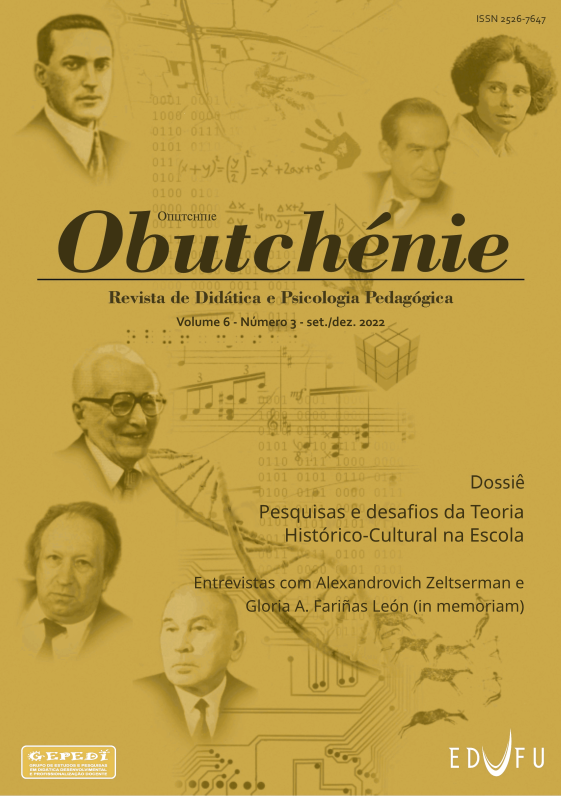
Dossier “Research and challenges ofHistorical-Cultural Theory in Schools” Presentation
Article Sidebar
Main Article Content
Abstract
This dossier, entitled “Research and Challenges of Historical-Cultural Theory in Schools,” presents part of the research carried out at the Center for Studies and Research on Vygotsky's School (NEEVY) at the Universidade Federal de São Carlos, which uses Historical-Cultural Theory as the basis for its investigations into school teaching and learning processes. Since 2003, this center has been training researchers, mainly in the area of school education: Basic Education, Youth and Adult Education, and Higher Education, focusing on the challenges, dilemmas, and issues related to school learning and the cultural development processes of students. The political importance of Historical-Cultural Theory for human cultural development processes is evident in the in-depth study of its assumptions and concepts, which explain and formulate possible paths for the cultural development of human beings toward self-control of their behavior in society. Especially in schools, such theoretical and methodological assumptions are essential for the transformation of teaching and learning processes, counteracting the exclusion of part of the population from cultural benefits and, in contrast, enabling them to access these cultural tools through the inseparability of the fundamental elements of school learning processes, namely, teaching, didactics, theory, and pedagogical practice.
Article Details
Section

This work is licensed under a Creative Commons Attribution-NonCommercial-NoDerivatives 4.0 International License.